
Part 7 Parking and Loading Requirements
7. Part 7 Parking and Loading Requirements
7.1. General Standards for Parking and Loading
7.1.1. The following requirements shall apply to all parking and loading facilities required by this Bylaw. Notwithstanding the requirements of this section, specific rules contained in any land use district shall govern the parking and loading requirements for that district.
7.1.2. Where parking or loading stalls are developed, the owner of the development shall provide the required parking and loading stalls, in accordance with this part, at the time of obtaining a development completion certificate.
7.1.3. When a development involves different land uses in one or more buildings, parking spaces may be provided and used collectively by all users, provided that the total number of parking spaces is equal to or greater than the sum of the requirements for each individual use.
7.1.4. Parking lots shall provide a 2.0m wide sidewalk to allow for pedestrian movement to the satisfaction of the Development Authority. These walkways shall cross the parking lot in each direction and align with building entrances.
7.1.5. Parking areas shall only be used for the temporary parking of motor vehicles and shall not be used for extended or continued storage of motor vehicles for a period in excess of forty-eight (48) hours, unless authorized by a development permit.
7.1.6. Within the Urban Service Area, parking areas, driveways, and approaches shall be hard-surfaced with asphalt, concrete, permeable pavers or a similar material excluding gravel, unless otherwise approved by the Development Authority.
7.1.7. Developments located outside the Urban Service Area may have parking areas and driveways that are surfaced with gravel.
7.1.8. There shall be at least one barrier free pedestrian access from a sidewalk to the building. Such access shall not cross vehicular circulation unless otherwise approved by the Development Authority.
7.1.9. For drive through developments with more than 25 parking stalls pedestrian circulation routes shall be provided and clearly demarcated in conjunction with vehicular circulation. The pedestrian circulation should be demarcated through the use of raised pedestrian crossings, signage, change in paving, painting, bollards, landscaping, or any other method.
7.1.10. Location
(a) Unless otherwise stated in this Bylaw, all parking stalls and loading spaces required by this Bylaw shall be located on the same lot as the use requiring it.
(b) Where a parking area accommodates five (5) or more parking stalls, a minimum 1.5m setback is required between the stall and all lot lines to accommodate grade changes and site landscaping.
(c) With the exception of special events, the use of portable barriers including but not limited to traffic barriers, crowd control barriers, or safety fences to define parking aisles are not permitted.
(d) The development of a parking lot shall not be permitted right up to a property line, with the exception of development of Lot 1 Block 24 Plan 1423070 and Lot 1A Block 24 Plan 1920676. A minimum of 1.5m separation is required to all property lines to accommodate grade changes and/or site landscaping. The Development Authority may consider parking lot development up to a property line in commercial districts if the request is submitted with a comprehensive parking plan for adjacent properties and which has incorporated site landscaping in accordance with Part 5 Section 5.27 Landscaping of this Bylaw.
7.1.11. For residential uses, the required parking stalls shall be accessible from a road, private road or common property.
7.1.12. For Commercial, Industrial and Institutional Land Uses
(a) The required parking spaces shall be surfaced and clearly demarcated to the satisfaction of the Development Authority prior to issuance of a development completion certificate, unless an extension has been granted due to weather conditions;
(b) Where a parking area is located on a site immediately adjacent to a residential district, a 1.5m buffer is required from the lot line, unless a fence, wall, or landscaping is provided and approved by the Development Authority.
7.1.13. For Apartments and Multi-residential Developments
(a) Parking spaces shall not be located between a building façade and a street unless otherwise approved by the Development Authority.
7.1.14. Visitor Parking
(a) Visitor parking stalls shall not be condominiumized and shall remain common property; and,
(b) Visitor parking stalls shall not change use.
7.1.15. On-site Snow Storage
(a) The location shall be identified to the satisfaction of the Development Authority.
(b) Parking stalls provided in excess of requirements under this Bylaw may be used as snow storage.
7.1.16. The stormwater drainage design for parking lots shall follow the Engineering Servicing Standards unless otherwise approved by the Development Authority.
7.1.17. Parking lots shall be landscaped in accordance with Part 5 Section 5.27 Landscaping of this Bylaw.
7.1.18. Parking Standards
(a) All parking spaces, loading spaces, maneuvering aisles and driveways shall be surfaced and maintained for the expected life of the development to the satisfaction of the Development Authority.
(b) Signage shall be provided to demarcate parking rows for better visibility when the ground is covered with snow shall be required.
(c) Driveway entrances onto a corner lot, other than in a residential district, shall be setback a minimum of 25.0m from any property boundary which fronts onto a street.
7.2. On-Site Parking Requirements
7.2.1. Size of Parking Stalls and Drive Aisle
(a) The minimum dimensions of parking stalls, drive aisles, and driveways are set out in Part 7 Section 7.2.1(g). The stall depth shall be measured from the face of the curb to the back of the stall and shall not include potential overhang onto landscaped areas or pedestrian walkways.
(b) For parallel parking, the length of the parking spaces shall be a minimum 7.0m, except that an end space with an open end shall be a minimum of 6.5m.
(c) Maneuvering aisles and driveways serving as fire lanes shall be a minimum of 6.0m wide and have a turning radius of 12.0m (bumper to bumper radius). If necessary, the Development Authority may require wider lane width and turn radius to facilitate the maneuvering of fire trucks.
(d) Maneuvering aisles and driveways intended for two-way truck movements shall be a minimum of 9.0m wide.
(e) Parking stalls shall be clear of obstructions except for concrete wheel stops.
(f) The grade of a parking stall shall not exceed four percent (4%) in any direction.
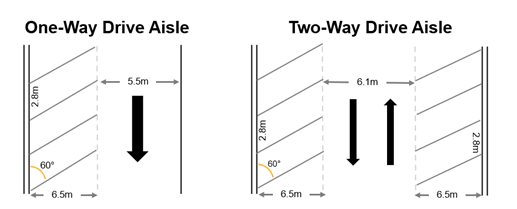
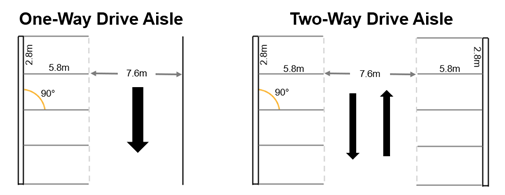
(g) The minimum parking stalls and drive aisle dimension requirements shall be as per Figure 7.1, 7.2, 7.3, 7.4, 7.5 and the table below:
|
Parking Angle (degrees) “a” |
Stall Width (metres) “b” |
Aisle Width, One-Way (metres) "c" |
Aisle Width, Two-Way (metres) “c” |
Stall Depth Perpendicular to Aisle (metres) “d” |
| 30 | 2.8m | 3.6m | 6.1m | 5.5m |
| 45 | 2.8m | 4.0m | 6.1m | 6.2m |
| 60 | 2.8m | 5.5m | 6.1m | 6.5m |
| 90 | 2.8m | 7.6m | 7.6m | 5.8m |
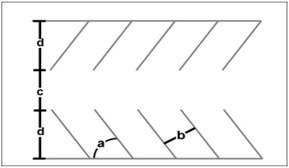 Figure 7.1 On-Site Parking Dimensions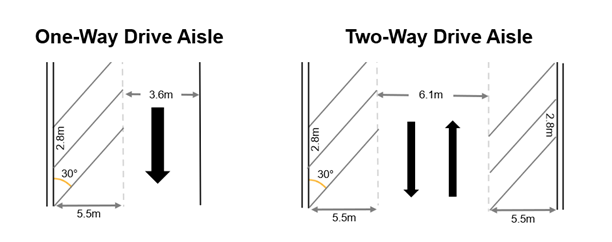
(h) The minimum accessible parking stalls dimension requirements shall be as per the table below:
|
Parking Angle (degrees) “a” |
Stall Width (metres) “b” |
Aisle Width (metres) "c" |
Stall Depth Perpendicular to Aisle (metres) "d" |
Access Aisle Width (metres) |
| 90 | 2.4m | 7.6m | 5.8m | 2.4 on one side |
Note: Two parking spaces may share an access aisle.
7.2.2. Requirements for Markings and Wheel Stops
(a) The portion or portions of a lot used for parking shall:
i. in the Urban Service Area, be marked off or physically divided to delineate clearly each parking stall, loading space or drive aisle;
ii. have wheel stops to prevent motor vehicles from encroaching onto landscaped areas or sidewalks and to protect fences, walls or buildings;
iii. wheel stops shall not exceed 0.15m in height above the parking stall surface and shall be placed perpendicular to the parking stall depth and shall be 0.60m from the front of the parking stall.
7.2.3. Required Number of On-site Parking Stalls:
(a) Where the calculation of the required number of parking stalls results in a fraction number of parking spaces, the next higher number shall be applied.
(b) Where a development falls within two (2) or more of the categories listed in this section, it shall comply with all of the parking requirements applicable to all of the categories.
(c) Where intensification of development on an existing developed site is proposed, the Development Authority may require the existing development to meet the parking stall requirements under this Bylaw.
(d) Minimum parking stalls required for uses not listed in this section shall be determined at the discretion of the Development Authority. A similar use, as determined by the Development Authority, will be considered when calculating the specific parking stall requirements for non-listed uses.
(e) When requiring a development permit, parking stall requirements for special events shall be based on a parking plan prepared to the satisfaction of the Development Authority.
(f) The minimum on-site parking stalls required for a use shall be as per the tables under each land use category outlined below.
7.2.4. Accommodation and Food Establishments Parking Stall Requirements
| Land Use | Minimum Parking Requirement |
| Accommodation Establishments | |
| Commercial guest accommodation | 1 stall per sleeping or housekeeping unit. |
| Resort facility | 1 stall per sleeping or housekeeping unit. |
| Exhibition, conference, and event centres | 10 stalls for every 100.0sq m of public floor area. |
| Campground |
A minimum one (1) parking stall per recreational vehicle stall. A minimum one (1) visitor parking stall per ten (10) recreational vehicle stalls shall be provided to the satisfaction of the Development Authority. |
| Food Service | |
| Restaurant, major and restaurant, minor | 1 stall per 3.5sq m of public floor area. |
| Restaurant with take out service | 5 stalls per 100.0sq m of public floor area of take out area. |
| Restaurant with drive through service | 1 stall per 3.5sq m of public floor area. |
| Restaurant with drive-in service | 1 stall per 3.0sq m of net floor area. |
| Other drive-in business | A maximum of 8 stalls unless otherwise approved by the Development Authority. |
| Drinking establishment and night club | 1 stall per 3.5sq m of public floor area. |
7.2.5. Businesses (Commercial/Industrial) Parking Stall Requirements
| Land Use | Minimum Parking Requirement |
|
a) Vehicle sales, service and rental |
3 stalls per 100.0sq m of net floor area. |
| b) Equipment service, sales, and rental | 3 stalls per 100.0sq m of net floor area. |
| c) Industrial and manufacturing uses | 1 stall per 100.0sq m of net floor area. |
| d) Office | 3 stalls per 100.0sq m of net floor area. |
| e) Office commercial | 3 stalls per 100.0sq m of net floor area. |
| f) Neighbourhood commercial | 3 stalls per 100.0sq m of net floor area. |
| g) Personal service facility | 3 stalls per 100.0sq m of net floor area. |
| h) Warehouse, storage and wholesale uses | 1.1 stalls per 100.0sq m of net floor area. |
7.2.6. Education, Government and Health Services Parking Stall Requirements
| Land Use | Minimum Parking Requirement |
| Education Services | |
| a) Elementary and junior high schools | 2.5 stalls per classroom plus 0.1 stalls per seat in gymnasium plus 3 pick-up/drop-off stalls per 100 students. |
| b) Senior high school | 2.5 stalls per classroom plus 0.20 stalls per student plus 0.1 stalls per seat in gymnasium. |
| c) College and university | 0.37 stalls per student. |
| d) Commercial school |
0.82 stalls per student. |
| Government Services | |
| e) Government services | 4.1 stalls per 100.0sq m of net floor area. |
| f) Library | 2.5 stalls per 100.0sq m of public floor area. |
| Health Services | |
| g) Child care facility | 1.5 stalls per employee on duty plus 1 pick up/drop off stall for every 30 children. |
| h) Health facility, major | 3.7 stalls per bed. |
| i) Health facility, minor and animal care services | 4 stalls per 100.0sq m net floor area. |
| j) Nursing homes | 0.4 stalls per bed. |
7.2.7. Residential Parking Stall Requirements
| Land Use | Minimum Parking Requirement |
|
a) Semi-detached dwelling and single detached dwelling |
2 stalls per dwelling unit. |
| b) Multi-unit dwelling | 2 stalls per dwelling unit plus 0.2 visitor parking stalls per dwelling unit. |
| c) Apartment – bachelor suite or 1 bedroom | 1 stall per dwelling unit plus 0.2 visitor parking stalls per dwelling unit. |
| d) Apartment – 2 bedroom | 1.5 stalls per dwelling unit plus 0.2 visitor parking stalls per dwelling unit. |
| e) Apartment – 3 bedroom | 2 stalls per dwelling unit plus 0.2 visitor parking stalls per dwelling unit. |
| f) Senior citizen housing – independent living | 0.3 stalls per dwelling unit plus 0.2 visitor stalls per dwelling unit. |
| g) Senior citizen housing – assisted living | 0.4 stalls per dwelling unit plus 0.2 visitor parking stalls per dwelling unit. |
| h) Mobile home | 2 stalls per dwelling unit. |
| i) Mobile home park | 2 stalls per dwelling unit plus 0.2 visitor parking stalls per dwelling unit. |
| j) Secondary suite | 1 stall per sleeping unit. |
| k) Boarding house | 1 stall per sleeping unit. |
| l) Home business, major | 1 stall per dwelling unit. |
| m) Bed and breakfast | 1 stall per sleeping unit plus 1 stall per off-site employee. |
| n) Live-work unit | 1 stall per dwelling unit plus 1 for every 50.0sq m of commercial use. |
7.2.8. Retail Parking Stall Requirements
| Land Use | Minimum Parking Requirement |
| Retail | |
| a) Retail, convenience | 3 stalls per every 100.0sq m of net floor area. |
| b) Retail, general | 1.5 stalls per every 100.0sq m of net floor area. |
| c) Liquor store and cannabis retail store | 4 stalls per every 100.0sq m of net floor area. |
| d) Service station | 1 stall per service bay. |
| e) Supermarket | 4 stalls per every 100.0sq m of net floor area. |
| Shopping centres | |
| f) Shopping centre | 5 stalls per every 100.0sq m of net floor area. |
7.2.9. Social and Recreational Services Parking Stall Requirements
| Land Use | Minimum Parking Requirement |
| Recreation facility, indoor and recreation facility, outdoor | 5 stalls per 100.0sq m of net floor area. |
| Bingo hall | 0.4 stalls per seat. |
| Religious assembly | 10 stalls per 100.0sq m of net floor area. |
| Curling rink | 8 stalls per sheet of ice plus 5 stalls for staff plus 0.1 stalls per seat for spectators. |
| Hockey rink /arena | 0.3 stalls per seat. |
| Golf course | 4 stalls per hole. |
| Health spa | 3 stalls per 100.0sq m of net floor area. |
| Racquet sports facility | 5 stalls per court. |
| Theatre and cinema | 0.3 stalls per seat. |
| Indoor playground | 1 stall per 100.0sq m of net floor area. |
| Casino | 1 stall per 100.0sq m of net floor area. |
| Detention facility | 5 stalls per 100.0sq m of net floor area. |
7.2.10. Mixed-use Developments
(a) Notwithstanding the on-site parking requirements, developments with more than one use shall provide parking stalls and loading spaces equal to the sum of the requirements for each individual use unless the applicant can demonstrate to the Development Authority that there is a complementary or overlapping use of the parking facilities which would warrant a reduction in the minimum on-site parking stalls required. The applicant shall demonstrate this reduction is warranted by submitting a parking study prepared by a professional to the satisfaction of the Development Authority.
(b) If a proposed use in a shopping centre has a higher minimum parking requirement than the minimum parking requirements for that shopping centre under Part 7 Section 7.2.8, the shopping centre shall provide sufficient on-site parking to accommodate the additional parking stalls associated with the proposed use.
7.3. On-Site Loading Requirements
7.3.1. Loading spaces shall be designed and located to accommodate the parking and maneuvering of vehicles without obstructing roads. The Development Authority may require turning movement diagrams to ensure satisfactory maneuverability within a site.
7.3.2. On-site loading areas shall be designed to ensure the safe and convenient circulation of vehicles to and from the road.
7.3.3. On-site loading spaces shall not allow backing out of vehicles onto a road.
7.3.4. On-site loading spaces shall have clear minimum dimensions as follows:
| Design Vehicle | Length (m) | Width (m) | Height (m) |
| a) Medium Single Unit Truck | 10.0 | 3.1 | 4.3 |
7.3.5. Minimum loading space dimensions may be varied by the Development Authority having regard to the types of vehicles that are likely to use the loading spaces.
7.3.6. Loading space requirements for uses not listed in this section shall be determined at the discretion of the Development Authority. A similar use as determined by the Development Authority will be considered when calculating the on-site loading requirements for non-listed uses.
7.3.7. Unless otherwise allowed by the Development Authority, the required on-site loading space for any use shall be as follows:
| a) Residential Use (For Apartments) |
|
| Number of Dwelling Units | Number of Spaces |
| i. Up to 20 | 1 space |
| ii. 21 to 60 | 2 spaces |
| iii. 61 or more | 1 space plus 1 space per each additional 40 dwelling units |
| b) Non-Residential Use | |
| Gross Floor Area (sq m) | Number of Spaces |
| i. Up to 1,500 | No requirement |
| ii. 1,501 to 5,000 | 1 |
| iii. 5,001 and up | 1 space plus 1 space per each additional 3,000.0sq m |
7.3.8. Notwithstanding the on-site loading requirements, where a development consists of a restaurant, major or restaurant, minor a loading stall shall be accommodated on-site. Where a development consists of a mix of residential and non-residential uses, the loading requirements shall be equal to the sum of the requirements for each individual use, unless the applicant can demonstrate to the Development Authority that there is a complementary or overlapping use of the loading facilities which would warrant a reduction in the minimum loading space required for each individual use. The applicant shall demonstrate this reduction is warranted by submitting a shared loading study prepared by a professional to the satisfaction of the Development Authority.
7.4. Off-Site Parking
7.4.1. Combined or Shared Parking Between Sites
(a) The Development Authority may consider shared parking at the time of development permit submission. The shared parking proposal needs to be substantiated by a parking study prepared by a professional to the satisfaction of the Development Authority.
(b) Parking demands include but are not limited to:
| Weekday Peaks | Evening Peaks | Weekend Peaks |
|
Banks |
Auditoriums |
Religious assembly |
7.4.2. The Development Authority may grant permission to share up to 20% of the required parking spaces with another site in the following circumstances and when supported by a shared parking study:
(a) the development is within 200.0m of the site on which the parking spaces are located;
(b) the demand for parking spaces for each development is not likely to occur at the same time as per Part 7 Section 7.4.1 (b);
(c) there is a walkway or pedestrian connection from the off-site parking site to the proposed development;
(d) a legal agreement is provided and parking arrangements are acceptable to the Development Authority;
(e) the legal agreement satisfies the Development Authority that the arrangement between the owners of the developments for the sharing of parking spaces will be permanent and registered on the title or an alternative arrangement has been made to the satisfaction of the Development Authority; and
(f) any change of use for a site referred to in a shared parking agreement requires a development permit and a new parking agreement.
7.4.3. The Development Authority may allow the required parking stalls to be provided off-site if:
(a) supported by a parking study applicable to the proposed development at the discretion of the Development Authority;
(b) the development is within 200.0m of the site on which the parking spaces are located;
(c) there is a walkway or pedestrian connection from the off-site parking site to the proposed development; and
(d) any change of use for a site referred to in a shared parking agreement requires a development permit and a new parking agreement or amendment to such agreement may be required subject to the discretion of the Development Authority.
7.4.4. In the case of Part 7 Section 7.4.2 or 7.4.3, a condition of the development permit shall require that a restrictive covenant or caveat to be registered on the title of the lot or lots on which parking spaces are located to the satisfaction of the Development Authority. The restrictive covenant or caveat shall stipulate:
(a) that the arrangement between the owners of the developments will be permanent for the life of the development in question or until an alternative arrangement has been made to the satisfaction of the Development Authority; and
(b) that in the case of Part 7 Section 7.4.3, the parking spaces shall be maintained exclusively for the parking requirements of the development in question.
7.5. Maintenance for Parking Lots and Loading Area During the Winter Season
7.5.1. Parking lots and loading areas shall be maintained and kept safe for its users, including safe access for emergency services vehicles.
7.5.2. Parking lots shall be cleared of ice and snow within forty-eight (48) hours after a snowfall.
7.5.3. Stored snow shall not pose a hazard to vehicular and pedestrian traffic.
7.6. Vehicle Queuing Requirements for Vehicular-Oriented Uses
7.6.1. Where a drive through is proposed as part of a development, it shall be accessory to the development.
7.6.2. Vehicular-oriented uses shall only be located where the Development Authority is satisfied that the development will not adversely affect the functioning of surrounding roads and nearby vehicle access locations.
7.6.3. No queuing stalls shall be allowed in the front yard.
7.6.4. The Development Authority may require greater setbacks for queuing stalls when considering adjacent land uses, vehicle circulation and/or access.
7.6.5. The drive through shall not have access directly from an arterial road.
7.6.6. The queuing stalls shall be contained entirely on-site and shall not overlap with or obstruct any parking stalls, drive aisles and roads.
7.6.7. Drive aisles shall have sufficient turning radius to accommodate vehicle entrance to queuing stalls.
7.6.8. When a drive through is an accessory use to a restaurant, major or restaurant, minor it shall maintain a minimum separation distance of 30.0m between queuing spaces and the lot line of a lot containing a residential development, except when separated from residential development by an arterial road.
7.6.9. The minimum on-site queuing spaces for drive through services shall be provided as follows:
| Uses | Number of Queuing Spaces | Dimension of Queuing Spaces |
| Drive Through Vehicle Services |
5 queuing spaces inbound for each service bay, |
7.0m long |
7.7. Design for Accessible and Senior Citizen Parking Stalls and Loading Zones
7.7.1. Accessible and senior citizen parking stalls shall be located as close as possible and within 30.0m from barrier free building entrances, elevators, ramps and walkways and be designed in such a way that users are not required to pass behind parked vehicles. The distance may be increased up to a maximum of 50.0m to accommodate site specific circumstances at the discretion of the Development Authority.
7.7.2. A ramp shall be provided to connect to a sidewalk when an accessible parking stall is adjacent to a building.
7.7.3. If a development requires more than two (2) accessible parking stalls and has more than one (1) accessible building entrance, at least one (1) accessible parking stall shall be located near each entrance.
7.7.4. Accessible parking stalls shall have minimum dimensions as per Part 7 Section 7.2.1 (h). Parallel accessible parking stalls shall be at least 7.0m in length.
7.7.5. Parking stalls for senior citizens shall have minimum dimensions as per Part 7 Section 7.2.1 (g). Each reserved senior citizen parking stall shall be marked with a sign.
7.7.6. Parking stalls for senior citizens are not required in the Rural Service Area.
7.7.7. Accessible parking stalls and parking for senior citizens shall be included as part of and not in addition to, the applicable minimum parking requirements.
7.7.8. Accessible parking and senior citizen stalls shall be provided as follows:
| Number of Parking Stalls Required | Number of Designated Accessible Stalls | Number of Designated Stalls for Use by Senior Citizens (only for non-residential uses) |
| 2-10 | 1 | 0 |
| 11-25 | 2 | 1 |
| 26-50 | 3 | 2 |
| 51-100 | 4 | 3 |
| For each additional increment of 100 | One additional stall | One additional stall |
7.7.9. Design and Construction of Accessible Parking Stalls
(a) Each parking stall shall be clearly identified by painting the international symbol of accessibility. The symbol shall be in white on a blue background and has minimum size of 1.0m by 1.0m.
(b) Each parking stall shall be marked with a wheelchair symbol sign with the message “Permit Required,” with black letterings on white background. The sign shall measure a minimum of 0.45m by 0.61m. The sign shall be at least 1.2m tall, measured from the ground to the bottom of the sign and be positioned to be easily seen by drivers.
(c) The access aisle shall be marked with diagonal striping with a strip spacing of 0.6m.
(d) The access aisle shall lead to a curb cut to the adjacent sidewalk connecting to a building entrance. The curb cut shall have a minimum width of 0.92m and shall have a desirable slope of no more than 1:12. A maximum slope of 1:8 may be approved at the discretion of the Development Authority.
(e) Parking stalls and the cross-slopes (in the longitudinal direction of the walk) of the sidewalk at the vicinity of the curb cut to the access aisle shall have a firm, slip-resistant and level surface with a maximum slope of 1:10. The areas of slope shall be painted with a non-skid yellow paint.
7.7.10. Design and Construction - Loading Zones for Specialized Transport Vehicles
(a) Loading zones shall be designed for side or rear loading/unloading operations.
(b) Vehicles with side operating platforms which are 0.76m wide by 1.05m long can discharge patrons at sidewalk level. An area of 1.5m by 1.5m is required on the sidewalk, beyond the platform to allow a person in a wheelchair to turn around and move in a new direction.
(c) A minimum height clearance of 3.0m shall be provided for van type transporters.
(d) A 0.92m curb cut shall be provided for transporters with a rear-mounted wheelchair lift.
7.8. Bicycle Parking
7.8.1. In addition to the required vehicular parking, bicycle parking shall be provided as follows:
| Land Use | Number of Required Parking Stalls |
| Apartment | 5% of required on-site vehicular parking stalls to a maximum of 10 stalls. |
| Commercial Districts and Institutional Districts excluding Educational Facilities | 5% of required on-site vehicular parking stalls to a maximum of 10 stalls. |
| Educational Facility | 10% of required on-site vehicular parking stalls to a maximum of 20 stalls. |
(a) If the minimum bicycle parking calculated based on Table 7.8.1 results in less than 5 bicycle stalls, the minimum requirements shall be 5 bicycle parking stalls.
7.8.2. Size and Location of Bicycle Parking Facilities
(a) Bicycle parking stalls shall be a minimum of 0.6m by 1.8m.
(b) Bicycle parking stalls shall have a vertical clearance of minimum 2.0m.
(c) The required bicycle parking stalls shall be provided on the same site as the proposed development.
(d) Adequate access and egress from bicycle parking stalls shall be provided with an aisle beside each parking row. The aisle shall be 1.5m in width.
(e) Bicycle parking stalls, access and egress are to be located on hard paved surfaces.
(f) Bicycle parking stalls shall be separated from vehicular parking by a physical barrier or a minimum 1.5m of open space.
(g) Bicycle parking stalls can be provided as secured storage rooms, racks, railings or similar facilities and shall be visible from the street or the main entrance of a building as follows:
i. inside the building, preferably at the ground level;
ii. within the parking facilities on a site;
iii. 15.0m from the main entrance of a building; and,
iv. shall be illuminated.
(h) If bicycle parking is not visibly located on site, directional signage shall be displayed indicating its location.
7.8.3. Bicycle parking shall be protected from the weather by an overhang, roof, awning, or covered walkway. The cover should extend at least 0.6m beyond the parking area and bicycle parking should be located away from roof drip areas.
7.9. Underground Parkade Requirements
7.9.1. Where any portion of a parkade is above grade, that portion shall comply with the building front, side and rear yard setback requirements for that district.
7.9.2. An underground parkade may be located closer to a lot line than the principal building at the discretion of the Development Authority, subject to the following conditions:
(a) a maximum encroachment of 3.0m may be permitted into the required front, side and rear yard setbacks;
(b) no encroachments will be permitted into registered easements or rights-of-way; and,
(c) any existing or proposed underground utility shall be more than 1.0m from the underground parkade.
7.9.3. A level stop zone (minimum 4.5m deep) is required to ensure that a vehicle entering or exiting an underground parkade can safely stop without interfering with pedestrian safety. Where views to pedestrians would otherwise be obstructed, diagonal corner cut-offs are required.
7.9.4. The maximum allowable ramp slope shall follow the latest Engineering Servicing Standards.
7.9.5. The entrance ramp to an underground parkade shall commence at the lot line and shall not be permitted to encroach onto a road right-of-way or lane.
7.9.6. The minimum entrance ramp width to a parkade shall be 6.1m, unless otherwise authorized by the Development Authority.
7.10. Approaches and Driveways
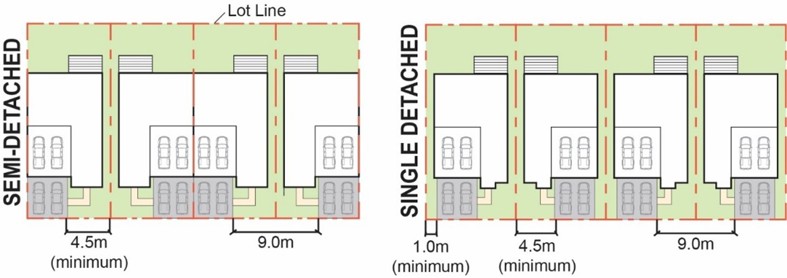
7.10.1. Except where joint driveways are required, driveways and parking pads shall require a minimum setback of 1.0m from a side lot line.
7.10.2. Driveways shall have a minimum width of 3.0m in the Urban Service Area and 6.0m for the Rural Service Area.
7.10.3. For front loading single detached dwellings and semi-detached dwellings, there shall be a minimum 4.5m separation distance between the edge of the driveway and at least one side lot line.
7.11. Secondary Suite Parking
7.11.1. Shall be accommodated in a designated area on a hard surface.
7.11.2. The on-site parking stall requirement for a secondary suite is in addition to the parking requirement for the mobile home, single detached dwelling or semi-detached dwelling.
7.11.3. All on-site parking stalls shall remain accessible for parking by passenger vehicles at all times and shall be directly accessible to the street or lane at all times.
7.11.4. Tandem parking is permitted if:
(a) tandem parking spaces are provided for the same dwelling unit; or
(b) one stall for the secondary suite and one stall for the principal dwelling unit are accessible to the street or lane at all times.
Contact Us
PULSE
Submit a request
Phone: 780-743-7000
Toll free: 1-800-973-9663
Subscribe for RMWB updates
Stay up to date on the services, programs and projects in your neighbourhood!