
Part 9 City Centre Area Redevelopment Special Area
Part 9 City Centre Area Redevelopment Special Area
9.1. General Purpose and Application
9.1.1. The general purpose of this part is to designate the City Centre area as a Special Area within the Municipality and to adopt the regulations in this part to achieve the objectives of the Downtown Area Redevelopment Plan within the City Centre Special Area.
9.1.2. This part applies to the areas designated as the City Centre Special Area.
9.1.3. The following Appendices are included in this part:
(a) Appendix A Map 39: City Centre Districts and Corridors Map
(b) Appendix A Map 40: City Centre Floor Area Ratio Map
(c) Appendix A Map 41: City Centre Height Map
9.2. Special Area Provisions
9.2.1. The regulations contained in this part apply to the areas designated as the City Centre Special Area as shown on Appendix A Map 39: City Centre Districts and Corridors Map.
9.2.2. Unless specifically excluded or modified by this part, the regulations in Part 1 to Part 5 of this Bylaw shall apply to the areas designated as the City Centre Special Area as shown on Appendix A Map 39: City Centre Districts and Corridors Map.
9.3. Definitions
9.3.1. In addition to the definitions in Part 1 Section 1.9 Definitions of this Bylaw, in this part, the following words shall have the following meanings:
|
Accessory Surface Parking |
means an area of land used for parking of motor vehicles on the surface of the parcel, which serves or is intended to serve the uses on the same parcel and may include but is not limited to customer parking, visitor parking and passenger pick up and drop off areas. Accessory surface parking also includes land used for parking of motor vehicles off the parcel where an arrangement for off-site parking has been established under Part 9 Section 9.15.6. Accessory surface parking excludes parking offered for uses not located on the parcel, except for cases where an arrangement for off-site parking has been established under Part 9 Section 9.15.6. |
|
Build-To Line |
means the line up to which buildings or landscaping shall be constructed. |
|
Building Frontage Type or Landscape Frontage Type |
the frontage types defined under Part 9 Section 9.16. |
|
City Centre Special Area |
includes the following areas as shown on Appendix A Map 39: City Centre Districts and Corridors Map: The Downtown Major Redevelopment Zone The Franklin Avenue Re-Urbanization Zone The Neighbourhood Stabilization Zone The Recreation Zone |
|
Commercial |
means a development designed to accommodate the buying and selling of goods and services. Commercial includes but is not limited to food and beverage commercial; limited commercial; office commercial; recreation commercial; restricted commercial; retail commercial (<5,000sq m gross floor area); retail commercial, large format (>5,000sq m gross floor area); service commercial; and tourism commercial. |
|
Corridor |
means a road designated as a corridor on Appendix A Map 39: City Centre Districts and Corridors Map. |
|
Food and Beverage Commercial |
means a development where the primary purpose is the sale of prepared food and beverages to the public for consumption on or off the premises, but does not include drive through food pick-up service. Food and beverage commercial includes, but is not limited to, food service, mobile catering; restaurant, major, restaurant, minor. Food and beverage commercial does not include drinking establishment; food service, drive-in or drive through; and nightclub. |
|
Gross Floor Area |
means the sum of the areas of all floors of a building measured to the outside surfaces of the exterior walls, or where buildings are separated by firewalls, to the centreline of the fire wall and includes all floors totally or partially above grade, and all floors totally below grade and includes all mechanical and electrical equipment areas, but does not include parking structures. |
|
Height |
has the meaning set out in Part 1 Section 1.9 of this Bylaw, except that in relation to a podium, the height shall be measured to the highest point of the podium structure, not including the tower portion or any other portion of the building. |
|
Institutional and Civic |
means a development for a public purpose and, may include but is not limited to such uses as schools, places of worship, community centres, health care facilities, public utilities and government buildings. Institutional and civic includes but is not limited to: child care facility; commercial school, major and commercial school, minor; community service facility; educational facility; essential public service; group home; health facility, major and health facility, minor; and religious assembly. |
|
Limited Commercial |
means a development designed, intended and/or used for assembling, auctioning, warehousing and/or storage, cleaning, servicing, repair and maintenance of goods and materials. Limited commercial includes but is not limited to: auctioneering facility; contractor, limited; custom manufacturing; equipment rental; fleet service; household equipment repair; and warehouse and storage. |
|
Live-Work |
includes, but is not limited to: secondary office commercial; retail commercial; household equipment repair; artist studio; making, processing, and assembly of products on a small scale; and personal service facility not including dry cleaning establishments. The entire unit occupied by the live-work shall be considered a dwelling unit, consisting of habitable rooms and non-habitable rooms. The work use shall not exceed fifty percent (50%) of the gross floor area of the dwelling unit and no activity which generates noise level, dust, odors or emissions incompatible with adjacent uses shall be permitted. |
|
Lot Line, Front (Front Lot Line) |
means any lot line common to a lot and a street other than a lane, except that: in the case of a corner lot at the intersection of two streets, the front lot line is the shorter of the two lot lines common to the lot and a street; in cases where a lot is contiguous to two streets (except corner lots), both lot lines shall be considered as front lot lines. |
|
Lot Line, Rear (Rear Lot Line) |
means the boundary of a lot which lies the most opposite to and is not connected to the front lot line and which is not contiguous to a street other than a lane; |
|
Low Wall |
means a low structure, usually less than 1m high, which serves to enclose or subdivide outdoor space, presenting a continuous surface, except where penetrated by walkways. The low wall is usually masonry, stone or concrete, but can be metal, wood or a combination of materials. |
|
Neighbourhood Commercial |
means a development that does not exceed a gross floor area of 1,000.0sq m, designed, intended or used to serve neighbourhood residents for: the purpose of receiving, storing and retailing consumer goods to the general public; or, providing personal services. Neighbourhood commercial includes but is not limited to: child care facility; personal service facility; retail, general; and retail, convenience. |
|
Office Commercial |
means a development designed, intended or used for the provision of professional, management, administrative, financial, health services, business, or similar services, or the administration of an industry, but shall not include retail commercial use. Office commercial includes, but is not limited to: broadcasting house; business support; financial institution; and office. |
|
Private Outdoor Amenity Space |
means an amenity space that is accessible directly from a dwelling, and may include a balcony, deck, patio, terrace or landscaped area, for private enjoyment of the resident of the dwelling, which may include visual cues such as fencing, railing or signage indicating the space is private. |
|
Podium |
means the continuous projecting base of a building, distinct from the tower or other portions of the building. A podium does not include a building for a spectator sports facility. |
|
Porch |
means a structure attached to a building to shelter an entrance or to serve as a semi-enclosed space; usually roofed and generally open-sided; although it may be enclosed through the use of screens, glass or partial walls. |
|
Recreation Commercial |
means a development of land, buildings or structures designed and equipped for the commercial conduct of sports, leisure and entertainment activities. Recreation commercial includes but is not limited to: arcade; commercial entertainment facility; recreation facility, indoor; and spectator sports facility. |
|
Residential |
means a development that contains one or more dwelling unitss. Residential includes but is not limited to: apartment; townhouse; senior citizen housing; duplex; triplex; fourplex; single detached dwelling; cluster housing; secondary suite; and semi-detached dwelling. |
|
Restricted Commercial |
means a development that may involve alcohol, nudity or gambling. Restricted commercial includes, but is not limited to: adult entertainment facility; casino; drinking establishment; and nightclub. |
|
Retail Commercial (<5,000sq m Gross Floor Area) |
means a development designed, intended or used for the purpose of receiving, storing and retailing goods to the general public provided that the building or structure in which the use is contained does not exceed a gross floor area of 5,000.0sq m. Retail, commercial (<5,000sq m gross floor area) includes, but is not limited to: liquor store; personal service facility; retail, general; retail, convenience; and shopping centre. |
|
Retail Commercial, Large Format (>5,000sq m Gross Floor Area) |
means a development designed, intended or used for the purpose of receiving, storing and retailing goods to the general public and for the wholesaling of goods to retailers, where the building or structure in which the use is contained, is equal to or exceeds a gross floor area of 5,000.0sq m and does not include the sale of motor vehicles, boats, and heavy equipment. Retail commercial, large format (>5,000sq m gross floor area) includes, but is not limited to: liquor store; personal service facility; retail, general; retail, convenience; and shopping centre, where the building or structure related to such use is equal to or exceeds a gross floor area of 5,000.0sq m. |
|
Secondary Office Commercial |
means a small scale office development designed, intended or used for the provision of professional, management, administrative, financial, health services, public service organizations, business, or similar services aimed at serving local residents, local households and locally owned businesses. Secondary office commercial excludes major offices that exceed a total gross floor area of 5,000.0sq m, which are better suited to be located in the Downtown Major Redevelopment Zone. Secondary office commercial uses do not exceed a total gross floor area of 5,000.0sq m within the building or structure in which the use is contained. |
|
Secondary Suite |
means one or more habitable rooms used or intended for use as a dwelling, with self-contained living facilities, and direct access to the exterior, without passing through any part of the principal dwelling unit. The secondary suite is subordinate to the principal dwelling unit. |
|
Service Commercial |
means a development designed, intended or used for the provision of services to businesses, vehicles, households, individuals or animals, but does not include personal service facilities or health care facilities. Service commercial specifically includes but is not limited to uses related to the sale, rental, servicing and repairing of motor vehicles, fuel, oils and accessories for motor vehicles, tools, equipment, and any similar goods and services. Service commercial includes, but is not limited to: animal care services, minor; automotive and equipment service; automotive/recreational vehicle sales and rental; gas bar; recycled materials drop- off centre; security suite; service station, major; and service station, minor. |
|
Stoop |
means a platform or small porch, usually up several steps, at the entrance to a building, usually a dwelling unit or dwelling units. |
|
Storey |
means that portion of a building, which is situated between the top of any floor and the top of the floor next above it. If there is no floor above, the storey is the portion of the building that is situated between the top of any floor and the ceiling above it. A storey is defined as having a vertical distance of less than 4.5m, and for any portion of a storey that exceeds 4.5m the building shall be defined to have an additional storey for every 4.5m. |
|
Street |
means a road, not including a lane. |
|
Street Facing Build-To Line |
means a build-to line adjacent to a road. |
|
Street Frontage |
means the portion of the parcel adjacent to a road. |
|
Terrace |
means a flat roof or a raised space or platform adjoining a building, or an embankment with a level top. A terrace is open to the sky and larger than a balcony, and may be above or below grade level. |
|
Threshold |
means the area of floor beneath a door, where two types of floor material meet; or the entrance to a building. |
|
Tourism Commercial |
means a development designed, intended or used to attract people visiting an area, or provide sleeping accommodation for the travelling public, and includes associated services and facilities. Tourism commercial includes, but is not limited to: apartment hotel; bed and breakfast; carnival; country inn; hostel; hotel; and motel. |
|
Tower |
means a building or a portion of a building located on top of a podium, with the height of the tower extending from the top of the podium to the top of the building. |
|
Trellis |
means an open grating or latticework overhead, of either metal or wood, and the supporting columns and framework. |
|
Urban Fence |
means an open framework screen or fence, of either metal, wood, masonry or a combination, usually no more than 1.5m high, which serves to enclose or subdivide outdoor space, presenting a semi-transparent surface, except where penetrated by walkways. |
9.4. Control of Development
9.4.1. Introduction
(a) The provisions of Part 9 Section 9.4 apply to the City Centre Special Area in addition to the provisions of Part 3 Development Decisions. Where a discrepancy exists between Part 9 Section 9.4 and Part 3 Development Decisions, the provisions of Part 9 Section 9.4 shall prevail.
9.4.2. Additional Powers
(a) The Development Authority may require that, as a condition of issuing a development permit, the applicant enter into an agreement with the Municipality to:
i. provide pedestrian access or pedestrian walkways, either by dedication of a public walkway or provision of an easement, in a street facing setback and to construct and maintain these pedestrian walkways for use by the public;
ii. provide connections to roads and pedestrian walkways, either by dedication of a public walkway or provision of an easement, in order to provide access for vehicles and pedestrians to the development, surrounding developments and services and amenities within the surrounding area; and
iii. provide pedestrian access or pedestrian walkways, either by dedication of a public walkway or provision of an easement, to or along the Riverfront District, the Snye and the Clearwater River.
9.4.3. Reconstruction of Existing Buildings
(a) Despite any other provisions in this Bylaw, if a building or structure within the City Centre Special Area that lawfully existed at the date of adoption of this Part, then:
i. repair or reconstruction of the building or structure that commences within one (1) year after the damage or destruction occurs and is completed as soon as reasonably practicable thereafter, and
ii. continuation of uses within the building or structure that lawfully existed at the date of adoption of this Part and that continue as soon as reasonably practicable after completion of the repair or reconstruction of the building or structure, are deemed to be conforming, provided that the repair or reconstruction meets the provisions of:
iii. Part 5 Section 5.18 Development in the Flood Management Area;
iv. Part 5 Section 5.19 Development Near Water Bodies, Watercourses and Steep Slopes; and
v. Part 5 Section 5.25 Hazard Lands and Top of Bank Setbacks.
9.4.4. Exemptions
(a) The following developments are exempt from the requirements in Part 9 Section 9.6 to Section 9.14 inclusive and Part 9 Section 9.17:
i. within a non-conforming building, enlargements or additions to a residential building, that constitute less than five percent (5%) of the building or 100.0sq m in gross floor area, whichever is greater, provided that such extensions do not result in an increase in the number of dwellings within the building or on the parcel;
ii. within a non-conforming building, enlargements or additions to a non-residential building, that constitute less than five percent (5%) of the building or 100.0sq m in gross floor area, whichever is greater.
(b) The following developments and uses are exempt from the requirement to provide specific building frontage types or landscape frontage types:
i. park; and,
ii. public plazas and squares.
9.5. Variance Powers
9.5.1. Non-conforming Buildings
(a) Notwithstanding Part 2 Section 2.4 Non-Conforming Uses and Buildings of this Bylaw, for development permit applications under this Part, the Development Authority may allow a variance and issue a development permit for a non-conforming building to building frontage types or landscape frontage types to accommodate parcel specific circumstances.
(b) The Development Authority may approve changes in use within a non-conforming building without requiring the building to be brought into conformance, provided that the proposed use is a permitted use or discretionary use.
9.5.2. Limitation on Variance
(a) In approving an application for a development permit under Part 2 Section 2.3 Variance Authority or Part 9 Section 9.5.1 of this Bylaw, the Development Authority shall adhere to the following regulations set out in this section.
(b) The Development Authority shall not allow a variance to the minimum parcel size except as set out in this section. The Development Authority may allow a variance of up to thirty-three percent (33%) reduction to the minimum parcel size required to achieve the maximum floor area ratio set out in Appendix A Map 40: City Centre Floor Area Ratio Map, if the development meets all the following criteria:
i. the development meets all of the requirements set out in Part 9 Section 9.9 Downtown Major Redevelopment Zone Development Standards, or Part 9 Section 9.10 Franklin Avenue Re-Urbanization Zone Development Standards as applicable to the parcel; and,
ii. at least one (1) corner of the parcel is located at the intersection of two (2) roads; and,
iii. a minimum setback of 10m is provided between the tower and the lot line adjacent to another parcel.
(c) The Development Authority shall not allow a variance from the maximum floor area ratio except as set out in this section. The Development Authority may allow a variance of the maximum floor area ratio by up to ten percent (10%).
(d) The Development Authority shall not allow a variance to the minimum height except as set out in this section. The Development Authority may allow a variance of the maximum height by up to ten percent (10%).
(e) Where the variance would result in a development that does not have fire protection access routes that are at least 8.0m wide on at least two (2) sides of a building, the Development Authority shall not allow a variance to:
i. building location and orientation,
ii. the location of roads, or
iii. the width of vehicular entrances.
(f) Despite Part 2 Section 2.3.2 the Development Authority may allow any variance in regard to front, side and rear yard setback requirements for existing or new principal buildings or accessory buildings, decks and signs.
9.5.3. Fundamental Design Regulations
(a) Within the Downtown Major Redevelopment Zone and the Franklin Avenue Re-Urbanization Zone, the Development Authority may vary the required building frontage types and landscape frontage types where a development follows fundamental design regulations, which include the following:
i. High quality public realm. Create a high-quality public realm that supports the culture of walking. This means that the pedestrian access is convenient, and the environment is comfortable, memorable and attractive. Streets and public spaces work together to provide opportunities for civic, cultural, economic and social activities.
ii. Pedestrian-friendly features. Create a pedestrian-friendly environment by orienting façades, entrances, outdoor seating areas, canopies, landscaping and other features that lend visual interest and a human scale to the street.
iii. Visual and physical connections. Develop visual and physical connections into buildings’ active interior spaces from adjacent sidewalks. Face main entries, lobbies and other pedestrian-oriented building elements to the sidewalk. Use architectural elements such as atriums, grand entries and large ground-level windows to reveal important interior spaces and activities.
iv. Flexible sidewalk-level spaces. Develop flexible spaces at the sidewalk-level of buildings that can accommodate a variety of active uses.
v. Corners. On corner lots wrap the façade treatment around the side of the building to provide a consistent profile facing both streets.
9.6. City Centre General Regulations
9.6.1. The following land use regulations are applicable to all development in the City Centre Special Area districts. Further regulation for specific uses may be described under individual land use districts.
9.6.2. Except as specifically excluded or modified in this section, Part 5 General Regulations shall apply to development within the City Centre Special Area.
9.6.3. Corner Lot Restrictions
(a) The provisions of Part 5 Section 5.16 Corner Lot Restrictions shall not apply to development within the CBD1, BOR1, SCL1, and SCL2 Districts of this part.
9.6.4. Development Setbacks from Highways
(a) The provisions of Part 5 Section 5.40 Setbacks from Highways shall not apply to development within the CBD1 District of this part.
9.6.5. Drive Through Service
(a) A drive through component proposed as part of a development shall meet the following regulations:
i. the drive through shall be accessory to the principal use of the development;
ii. the drive through lane shall not be located between the building it serves and front lot line or a designated corridor;
iii. if the parcel is located on lot with two front lot lines, then the drive through lane may be located between the building and the front lot line, as long as the front lot line is not adjacent to a corridor;
iv. the entrance to the drive through lane shall not be on Franklin Avenue, Hospital Street, or King Street;
v. the primary entrance to the building shall be a pedestrian oriented entrance; and
vi. the drive through lane shall be at the rear of the parcel, located between the building it serves and the rear lot line. If no rear lot line exists, then the rear lot line is deemed as the lot line most opposite a corridor, and if located on more than one corridor, then most opposite the higher order corridor.
(b) Notwithstanding any other provision of this part, where it is an accessory use, a drive through component shall be considered as a discretionary use and may be approved or refused at the discretion of the Development Authority.
9.6.6. Landscaping
(a) The provisions of Part 5 Section 5.27 Landscaping of this Bylaw shall apply to all development within this part, except for:
i. developments where one hundred percent (100%) parcel coverage for buildings is permitted and provided, at the discretion of the Development Authority; and
ii. additions to existing buildings, where the addition is less than 1,000.0sq m in gross floor area.
9.6.7. Signage
(a) The Development Authority shall have regard for visual harmony and the compatibility of any proposed sign with the architectural character and finish of the development and with the design, location and appearance of other signs on the development.
9.6.8. Transparency
(a) The windows required for each building frontage types and landscape frontage type shall be comprised of transparent, non-reflective, non-tinted, non-obscured glazing, except in the case of restricted commercial uses where reflective tinted or obscuring glazing is permitted.
9.6.9. Ground Floor Height Measurement
(a) If a minimum ground floor height is required, with a specific minimum floor to ceiling measurement, the ceiling shall be considered as the bottom of joists, rafters or supporting structure of the roof or floor structural system above; the floor shall be considered as the highest point of any flooring system. The ceiling does not include any non-structural ceiling surface materials such as suspended acoustical tile. Projections such as pendant lighting, exposed mechanical ducting, exposed electrical or communication raceways, or the bottom chord of structural trusses may extend below the ceiling and shall not be included in the floor to ceiling measurement.
9.7. The City Centre Districts and Corridors Map – The Regulating Plan
9.7.1. The Regulating Plan is set out in Appendix A Map 39: City Centre Districts and Corridors Map. Appendix A Map 39: City Centre Districts and Corridors Map sets out the corridor and land use districts that apply to each parcel.
9.7.2. The corridor type that applies to a specific street or section of a street is indicated by the colour and corresponding name shown on Appendix A Map 39: City Centre Districts and Corridors Map.
9.7.3. On Appendix A Map 39: City Centre Districts and Corridors Map, where the corridor type, as indicated by the mapping colour, extends through an intersection, that corridor type shall be considered as the higher order corridor and shall apply to the intersection, and to the intersecting street until a distance of 30m from the confluence of lot lines at the corner, or until the next lot line away from the corner, whichever distance is shorter.
9.7.4. Where a parcel is adjacent to more than one (1) corridor type, the corridor type that is adjacent to the lot line shall be the corridor type that applies to that portion of the lot within 30m of the corridor. Where more than one (1) corridor type applies on a corner, then the higher order corridor shall apply.
9.7.5. The land use district that applies to a lot is indicated by the colour and letter designations set out on Appendix A Map 39: City Centre Districts and Corridors Map.
9.8. Interpretation of Development Standards Tables
9.8.1. In each table, the applicable corridors are stated at the top of each column. Development on any parcel adjacent to a corridor shall follow the applicable regulations set out in the relevant table. Development on any parcel not adjacent to a corridor shall follow the regulations set out in the Downtown General, or Franklin Re-urbanization General columns as the case may be.
9.8.2. In each table, the far-left column sets out the item to be regulated. A description of each of those items to be regulated is as follows:
(a) Maximum block length: regulates the maximum distance of the long edge of a city block bounded by streets, measured from the lot line of the lot at one end of the block to the lot line of the lot at the other end of the block. Maximum block length is often combined with the maximum perimeter of the city block, measured along the outside of the lots and the ends of the lane that comprise the block. The perimeter includes the sum of the front lot lines, exterior side lot lines and the width of each lane entrance. Maximum block length applies to the creation of new streets and blocks.
(b) Lot area: regulates the minimum or maximum lot area.
(c) Lot width: regulates the minimum or maximum lot width. Lot width includes lot width corner, lot width irregular and lot width regular.
(d) Vehicular entrances permitted: regulates whether driveways are permitted from the street to the site from a designated corridor. This regulation does not control access provided from rear lanes; vehicle entrances are permitted from rear lanes unless specifically stated otherwise.
(e) Vehicular entrances: regulates the location and proximity of driveways to each other.
(f) Vehicular entrance width: regulates the maximum width of driveway entrances, measured at the widest point of the dropped curb for the entrance.
(g) Pedestrian access required: regulates the number of building entrances that are directly connected to the public sidewalk by a pedestrian walkway that is a minimum of 1.8m wide.
(h) Front street facing setback: regulates the minimum distance required between the building and the front lot line.
(i) Side yard setback: regulates the minimum width of the side yard.
(j) Rear yard setback: regulates the minimum width of the rear yard.
(k) Minimum building or podium height: regulates the minimum height of buildings or podium structures.
(l) Maximum podium height: regulates the maximum height of podium structures. Maximum podium height does not apply to spectator sports facilities.
(m) Maximum tower height: regulates the maximum height of tower structures.
(n) Tower location: regulates the location of tower structures in relation to other towers and the street facing portion of the podium upon which the tower is located.
(o) Maximum tower floor plate: regulates the maximum area of a single storey of the tower.
(p) Maximum podium or tower span over East-West through block connection: regulates the maximum distance along an East-West lane that may be covered by a podium or tower portion of a building.
(q) Lot coverage: regulates the maximum lot coverage.
(r) Structured parking setback: regulates the setback of parking structures from all lot lines.
(s) Street-facing surface parking lot setback: regulates whether or not surface parking is permitted on the parcel between the building and the street, and if permitted, the setback required between the front lot line and the parking lot.
(t) Side yard surface parking lot setback: regulates whether or not surface parking is permitted between the building and side lot line, and if permitted, the setback required between the side lot line and the parking lot.
(u) Minimum building frontage type or landscape frontage type along street facing build-to line: regulates the minimum percentage of the front setback line that shall be occupied by a building. The front setback line is the line extending across the front of the parcel at the front setback distance.
(v) Building frontage types and landscape frontage types permitted: regulates the type of building frontage types and landscape frontage types permitted on a parcel, and each building frontage type and landscape frontage type is identified in Part 9 Section 9.16.
9.9. Downtown Major Redevelopment Zone
9.9.1. Permitted and Discretionary Uses
(a) In the tables below, the applicable land use districts are stated at the top of each column, and the types of permitted or discretionary uses at the left end of each row. A permitted use is indicated by a solid circle at the intersection of the land use district column and the use row. A discretionary use is indicated by an open circle at the intersection of the land use district column and the use row.
(b) The applicable land use districts are set out in the Regulating Plan: Appendix A Map 39: City Centre Districts and Corridors Map.
(c) The permitted and discretionary uses for each land use district in the Downtown Major Redevelopment Zone are set out below.
| Land Use | CBD1 – Central Business District | BOR1 - Borealis | SCL1 – Snyeside /Clearwater Core | SCL2 – Snyeside /Clearwater High Density |
| ● = Permitted Use ○ = Discretionary Use ○* = Discretionary Use – Notice Posting | ||||
| Food and Beverage Commercial | ● | ● | ○ | ○ |
| Institutional and Civic | ● | ● | ● | ● |
| Office Commercial | ● | ● | ○ | ○ |
| Park | ● | ● | ● | ● |
| Parking Structure | ● | ● | ● | ● |
| Recreation Commercial | ● | ● | ||
| Residential | ● | ● | ● | ● |
| Retail Commercial (<5,000sq m gross floor area) | ○ | |||
| Restricted Commercial | ○ | |||
| Service Commercial | ○ | |||
| Tourism Commercial | ● | ● | ● | ● |
| Home Business, Minor | ● | ● | ● | ● |
| Home Business, Major | ○ | ○ | ○ | ○ |
| Accessory Surface Parking | ○ | ○ | ○ | ○ |
| Accessory Building | ● | ● | ● | ● |
| Special Event | ○* | ○* | ○* | ○* |
| Cannabis Retail Store | ○* | |||
| Drive Through | ○ | |||
9.9.2. General Standards Required for All Development in the Downtown Major Redevelopment Zone
(a) Introduction
i. The following standards apply to all development in the Downtown Major Redevelopment Zone unless noted otherwise.
(b) Connectivity
i. Connectivity maximum block length: New streets are intended to create blocks with a maximum block length of 180.0m, and a perimeter no greater than 530.0m, unless otherwise noted. Exact location of these new streets may vary up to 16.0m, provided this provision is met.
(c) Site Access
i. Vehicular entrances: a parcel may have vehicular entrances that meet the development standards shown in table of specific development standards.
ii. Vehicular entrance width: 8.0m maximum width, not including any sidewalks or landscaping.
(d) Frontage Requirements
i. Minimum building frontage along street facing build-to line: all private and public street or path-facing build-to lines not occupied by buildings or driveways are required to provide building frontage types or landscape frontage types between the sidewalk and the remainder of the parcel. See table of specific development standards for permitted building frontage types and landscape frontage types.
ii. Primary street frontage: the primary street frontage shall be defined as the portion of the building facing the street (or the higher order street corridor if on a corner). The front façade of the building shall be built to the primary street frontage build-to line.
iii. Secondary street frontage: the secondary street frontage shall be defined as the portion of the building facing the lower order street, if on a corner. The front façade of the building shall be built to the secondary street frontage build-to line for a minimum of 30.0m from the corner or the lot width, whichever is shorter. The building frontage standards of this section shall apply to the portion of the building that occupies the build-to line for 30.0m from the corner or the lot width, whichever is shorter.
(e) Building Setbacks
i. Front street facing setback: varies according to building frontage type or landscape frontage type. See Part 9 Section 9.16 Building and Landscape Frontage Types for standards.
ii. Side yard setback, adjoining another lot: see table of specific development standards.
iii. Rear yard setback, adjoining another lot: see table of specific development standards.
iv. Rear yard setback, adjoining a lane: see table of specific development standards.
(f) Parking Siting and Screening
i. Parking structure setbacks: parking structure setbacks are the same as principal building setbacks. Parking structures shall comply with all building frontage requirements outlined in Part 9 Section 9.16 Building and Landscape Frontage Types.
ii. Surface parking lots not directly serving a primary commercial, institutional, residential or other primary use on the parcel are not allowed within the CBD1 District.
iii. A Low Wall and Trellis Landscape Frontage or an Urban Fence or Wall Landscape Frontage shall be provided along the boundary of surface parking lots or accessory surface parking lots adjacent to streets upon redevelopment of an existing development.
(g) Amenity Spaces
i. A minimum amenity space of three percent (3%) of the gross floor area of residential uses, shall be required for buildings over 2,000.0sq m to the satisfaction of the Development Authority, but in no case shall the amenity space be less than an average of 3.0sq m of private outdoor amenity space per dwelling unit (total private outdoor amenity space for all dwelling units divided by the number of dwelling units shall be a minimum of 3.0sq m).
ii. Amenity spaces for residential uses may include but are not limited to meeting rooms, fitness facilities, outdoor space, and balconies, and shall be exempt from floor area ratio calculations.
(h) Dwelling Units Permitted
i. The maximum number of dwelling units permitted is the number of dwelling units that can be achieved while complying with the uses and applicable development standards, which may include but are not limited to, the maximum height, maximum floor area ratio, building frontage type, parking requirements, permitted uses and discretionary uses, and all other regulations that apply to the development.
9.9.3. Tables of Specific Development Standards for Downtown Major Redevelopment Zone
(a) Introduction
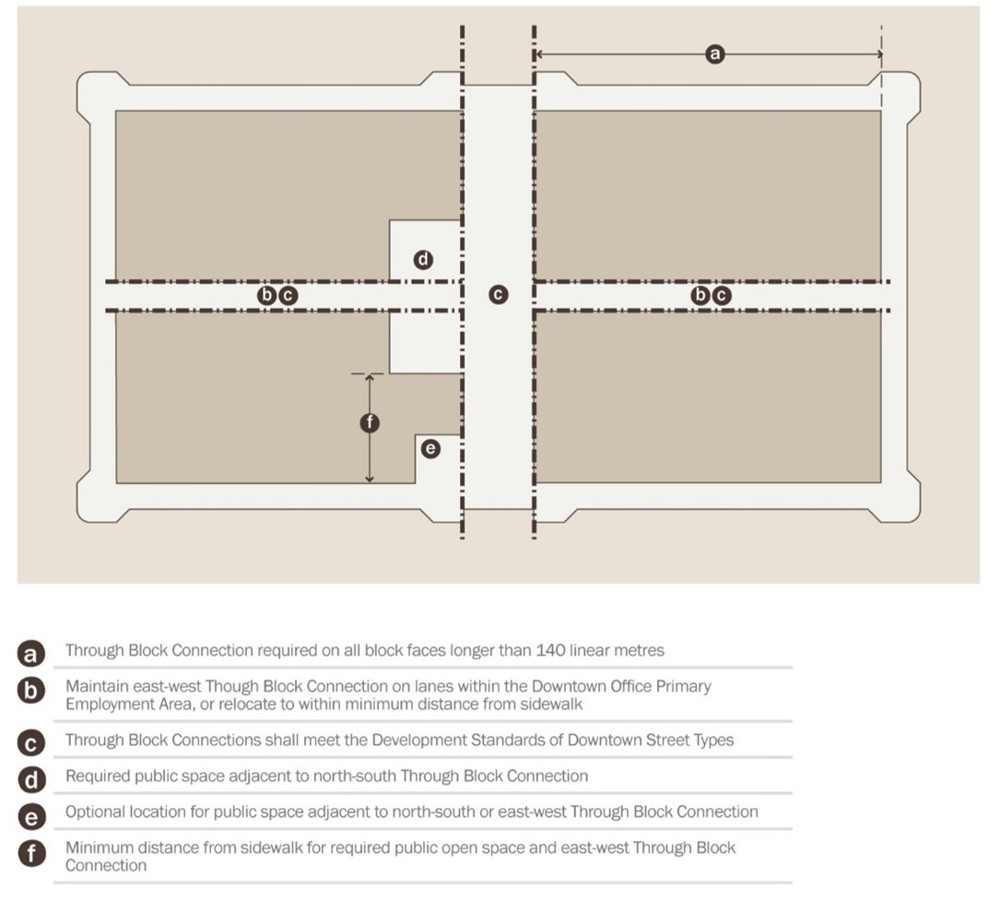
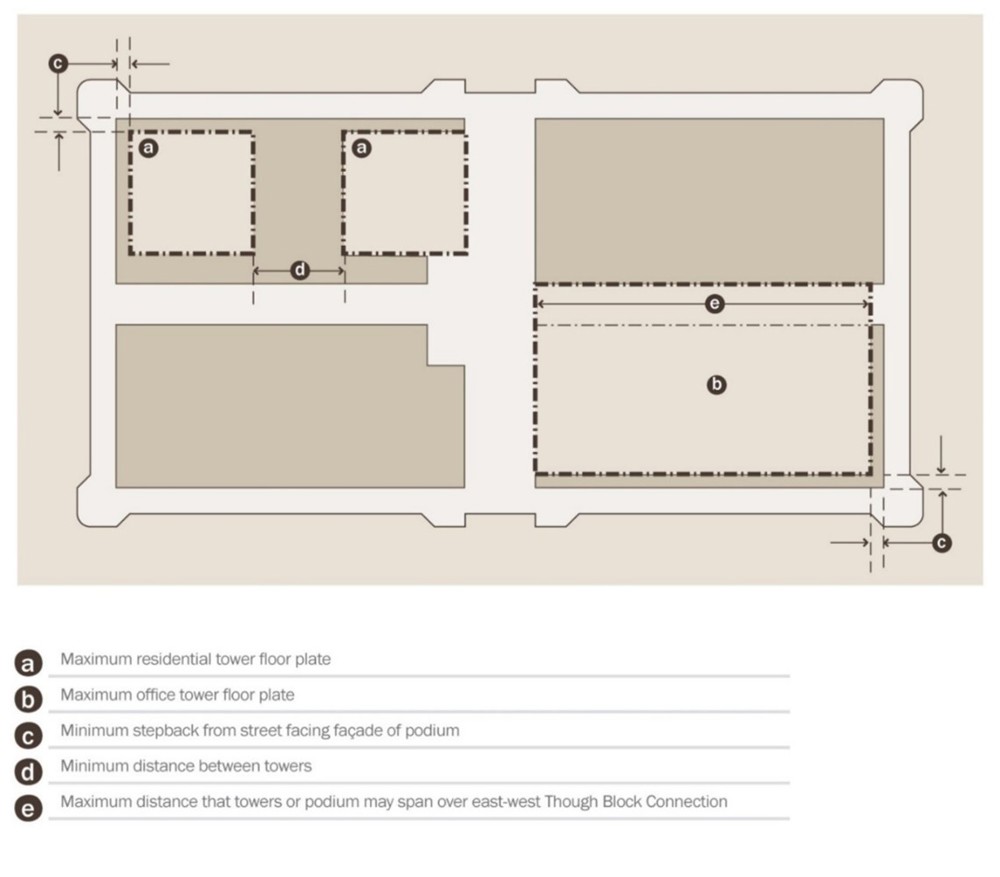
i. Table 9-1 sets out specific development standards for lots fronting each of the corridors within the Downtown Major Redevelopment Zone as set out in Appendix A Map 39: City Centre Districts and Corridors Map.
ii. See Figure 9.1 and Figure 9.2 for graphic illustrations of the development standards within the Development Standards Table.
iii. The Downtown General column applies to all parcels not fronting on a corridor set out in Appendix A Map 39: City Centre Districts and Corridors Map.
|
Table 9-1 Regulating Plan Areas Downtown Major Redevelopment Zone |
|||||||||
| Specific Development Standards by Area | Downtown General | Franklin West | Morrison | MacDonald | Main | Hardin North | Hardin South | Father Mercredi | Clearwater West |
| Connectivity and Urban Structure Standards | |||||||||
| Maximum Block Length | 180m | 180m | 85m | 180m | 85m | 180m | 85m | 270m | 200m |
| Maximum Block Perimeter | 530m, except where noted | 530m | 530m | 530m | 530m | 530m | 530m | 645m | 570m |
| Site Access | |||||||||
| Driveways | Permitted except where noted | Discretionary | Discretionary | Permitted except where noted | Permitted except where noted | Discretionary | Discretionary | Permitted except where noted | Permitted except where noted |
| Vehicular Entrances |
Min. 12m separation from intersection Max. avg. 1 driveway per 30m of block frontage |
Min. 12m separation from intersection Max. avg. 1 driveway per 30m of block frontage, right-in, right- out only |
N/A |
Min. 12m separation from intersection Max. avg. 1 driveway per 30m of block frontage |
Min. 12m separation from intersection Max. avg. 1 driveway per 30m of block frontage |
N/A | N/A |
Min. 12m separation from intersection Max. avg. 1 driveway per 30m of block frontage |
Min. 12m separation from intersection Max. avg. 1 driveway per 30m of block frontage |
| Vehicular Entrance Width | Max. 8m | N/A | N/A | Max. 8m | Max. 8m | N/A | N/A | Max. 8m | Max. 8m |
| Building Siting and Massing |
|||||||||
| Front Street Facing Setback | As per building frontage type | 1m at grade | 1m at grade | 1m at grade | 1m at grade | 3m at grade | 1m at grade | 3m at grade | As per building frontage type |
| Side Yard Setback | Minimum 0m | ||||||||
| Rear Yard Setback | Minimum 0m | ||||||||
| Minimum Building or Podium Height | None | 2 storeys or 6m | 2 storeys or 6m | 2 storeys or 6m | 2 storeys or 6m | 2 storeys or 6m | 2 storeys or 6m | 2 storeys or 6m | 2 storeys or 6m |
| Maximum Podium Height | None | 6 storeys or 20m | 6 storeys or 20m | 6 storeys or 20m | 6 storeys or 20m | 6 storeys or 20m | 6 storeys or 20m | 6 storeys or 20m | 6 storeys or 20m |
| Maximum Tower Height | See Appendix A Map 41 City Centre Height Map | ||||||||
| Tower Location |
Minimum 3m setback from street face of podium |
||||||||
| Maximum Tower Floor Plate |
Residential: 1,200.0sq m |
||||||||
| Parking Siting |
|||||||||
| Parking Structure Setback | Same as primary building setback. Shall comply with building frontage type requirements | ||||||||
| Street-Facing Surface Parking Lot Setback | Street-facing surface parking is not permitted | ||||||||
| Side Yard Surface Parking Lot Setback |
Min. 1.5m Min. 0m for attached buildings and/or shared lots |
Side yard surface parking is not permitted | Side yard surface parking is not permitted | Side yard surface parking is not permitted | Side yard surface parking is not permitted | Side yard surface parking is not permitted | Side yard surface parking is not permitted | Side yard surface parking is not permitted |
Min. 1.5m Min. 0m for attached buildings and/or shared lots |
| Frontage Requirements |
|||||||||
| Minimum building frontage type or landscape frontage type Along Street-facing Build- To Line | 100% | ||||||||
9.9.4. Snyeside Clearwater Residential Area
(a) Within the Snyeside Clearwater Residential Area shown on Appendix A Map 39: City Centre Districts and Corridors Map, the following regulations apply:
i. The R1 Low Density Residential District regulations shall apply to parcels that meet any one of the following conditions:
1. a parcel area of less than or equal to 0.3ha; or
2. a lot frontage of less than or equal to 50.0m; or
3. a lot depth of less than or equal to 50.0m.
ii. A site plan, to the satisfaction of the Development Authority, shall be submitted prior to development of parcels that meet all of the following conditions:
1. a parcel area greater than 0.3ha; and
2. a lot frontage greater than 50.0m; and
3. a lot depth greater than 50.0m.
iii. The site plan shall show the ultimate build-out of the entire parcel and demonstrate how the overall development will meet the requirements of this Bylaw. The additional uses, heights, and floor area ratios set out in Part 9, beyond those permitted in the R1 Low Density Residential District, shall not be allowed until a site plan has been submitted to the satisfaction of the Development Authority, in addition to all other requirements.
9.10. Franklin Avenue Re- Urbanization Development Standards
9.10.1. Permitted and Discretionary Uses
(a) In the tables, the applicable land use districts are stated at the top of each column, and the types of permitted or discretionary uses at the left end of each row. A permitted use is indicated by a solid circle at the intersection of the land use district column and the use row. A discretionary use is indicated by an open circle at the intersection of the land use district column and the use row.
(b) The applicable land use districts are set out in the Regulating Plan: Appendix A Map 39: City Centre Districts and Corridors Map.
(c) The permitted and discretionary uses for each land use district in the Franklin Avenue Re-Urbanization Zone are set out below
| Land Use | PRA1 – Prairie West of Queen Mixed Use | PRA2 – Prairie East of Queen Mixed Use | FRA1 – Franklin Core |
| ● = Permitted Use ○ = Discretionary Use ○* = Discretionary Use – Notice Posting | |||
| Food and Beverage Commercial | ● | ● | ● |
| Institutional and Civic | ● | ● | ● |
| Limited Commercial | ○ | ○ | ○ |
| Office Commercial | ● | ● | ● |
| Park | ● | ● | ● |
| Parking Lot/Structure | ● | ● | ● |
| Recreation Commercial | ● | ● | ● |
| Residential | ● | ● | ● |
| Retail Commercial (<5,000sq m gross floor area) | ● | ● | ● |
| Retail Commercial, Large Format (>5,000sq m gross floor area) | ● | ○ | |
| Restricted Commercial | ○ | ○ | ○ |
| Service Commercial | ● | ● | ● |
| Tourism Commercial | ○ | ○ | ● |
| Home Business, Minor | ● | ● | ● |
| Home Business, Major | ○ | ○ | ○ |
| Accessory Surface Parking | ● | ● | ● |
| Accessory Building or Use | ● | ● | ● |
| Cannabis Retail Store | ○* | ○* | ○* |
| Special Event | ○* | ○* | ○* |
| Drive Through | ○ | ○ | ○ |
9.10.2. General Standards Required for All Development in the Franklin Avenue Re- Urbanization Zone
(a) Introduction
i. The following standards apply to all development in the Franklin Avenue Re-Urbanization Zone unless noted otherwise in Table 9-2.
(b) Connectivity
i. Maximum block length: new streets are intended to create blocks with a maximum block length of 180.0m, and a perimeter no greater than 530.0m, unless otherwise noted. Exact location of these new streets may vary up to 16.0m, provided this provision is met.
(c) Site Access
i. Vehicular entrances: a parcel may have vehicular entrances that meet the development standards shown in the table of specific development standards.
ii. Vehicular entrance width: 8.0m maximum width, not including any sidewalks or landscaping.
iii. Pedestrian access: all buildings shall provide at least one building entrance that is directly connected to the public sidewalk by a walkway that is a minimum of 1.8m wide. This building entrance shall be operable during normal business hours.
(d) Frontage Requirements
i. Minimum building frontage along street facing build-to line: all street or path-facing build-to lines not occupied by buildings or driveways are required to provide a building frontage type or landscape frontage type between the sidewalk and the remainder of the lot. See the Table of Specific Development Standards for permitted building frontage types and landscape frontage types.
ii. Primary street frontage: the primary street frontage shall be defined as the portion of the building facing the street (or the higher order street corridor if on a corner). The front façade of the building shall be built to the primary street frontage build-to line.
iii. Secondary street frontage: the secondary street frontage shall be defined as the portion of the building facing the lower order street, if on a corner. The front façade of the building shall be built to the secondary street frontage build-to line for a minimum of 30.0m from the corner or the lot width, whichever is shorter. The building frontage standards of this section shall apply to the portion of the building that occupies the build-to line for 30m from the corner or the lot width, whichever is shorter.
(e) Building Setbacks
i. Front street facing setback: varies according to building frontage type and landscape frontage type.
ii. Side yard setback, adjoining another lot: see table of specific development standards.
iii. Rear yard setback, adjoining another lot: see table of specific development standards.
iv. Rear yard setback, adjoining a lane: see table of specific development standards.
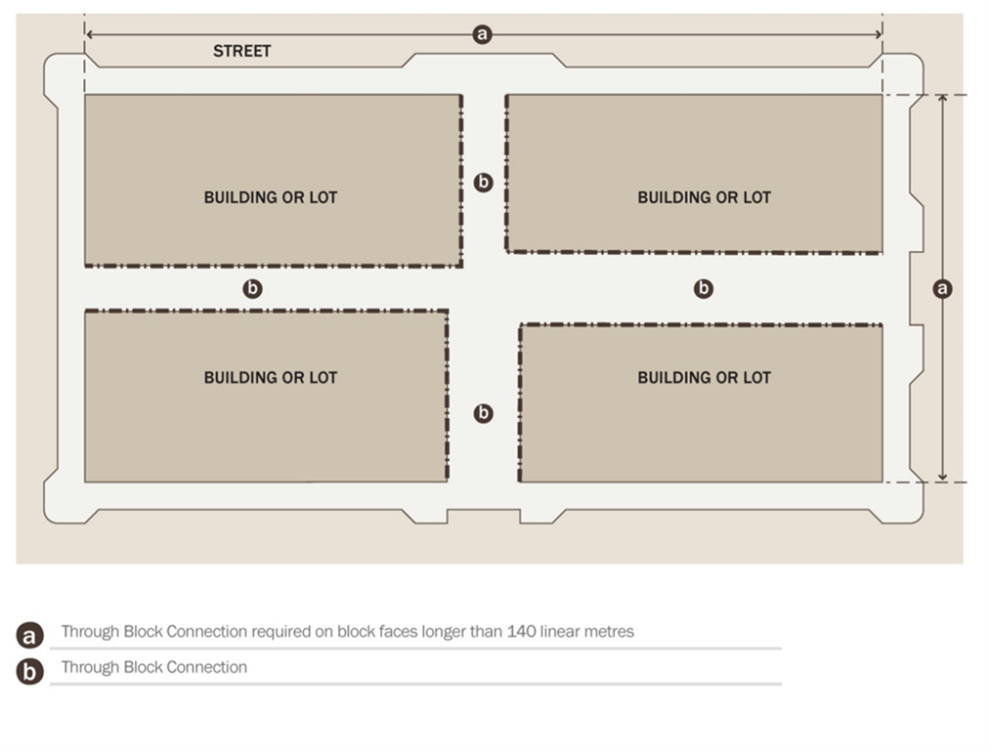
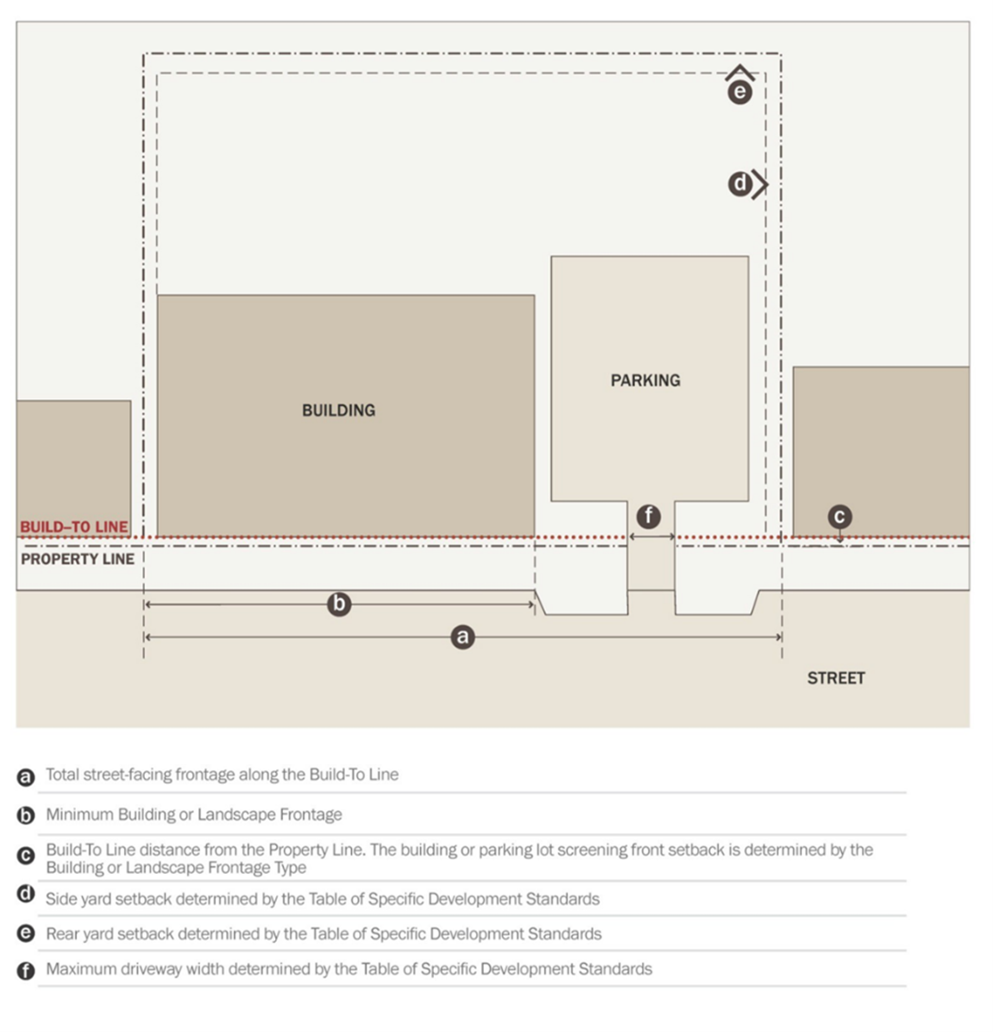
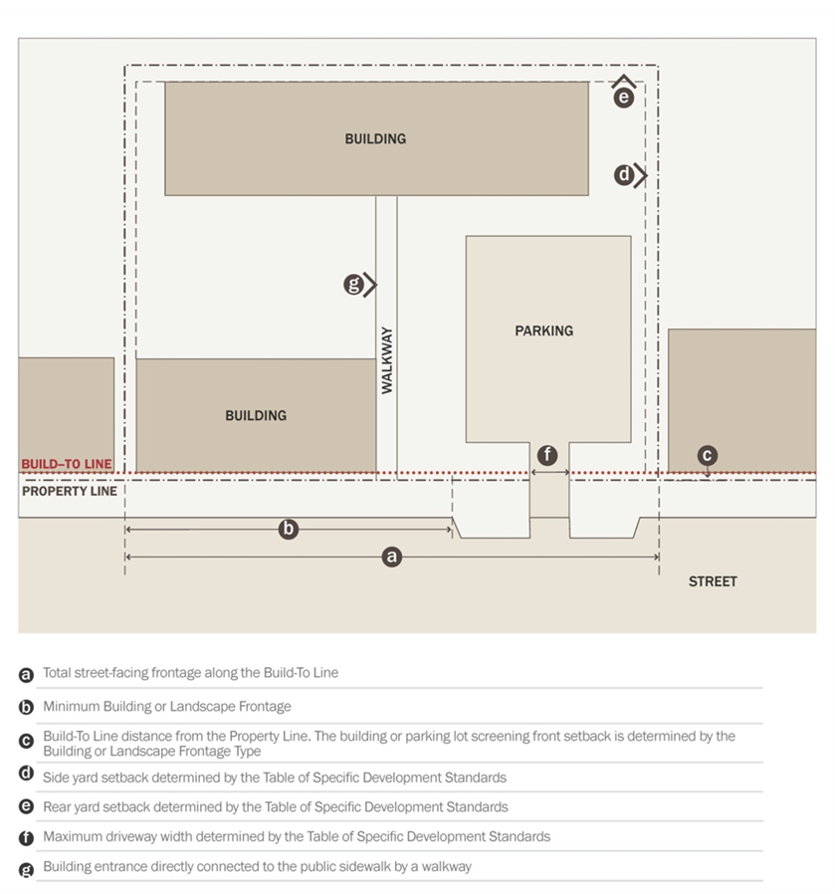
v. Building siting requirements are illustrated in Figure 9.3, Figure 9.4 and Figure 9.5.
(f) Parking Siting and Screening
i. Parking structure setbacks: parking structure setbacks are the same as principal building setbacks. Parking structures shall comply with all building frontage requirements outlined in Part 9 Section 9.16 Building and Landscape Frontage Types.
ii. Street-facing setbacks: see Part 9 Section 9.16 Building and Landscape Frontage Types for setback and landscaping requirements for surface parking areas.
iii. Parking siting requirements are illustrated in Figure 9.4 and Figure 9.5.
(g) Amenity Spaces
i. A minimum amenity space of three percent (3%) of gross floor area of residential uses, shall be required for buildings over 2,000.0sq m to the satisfaction of the Development Authority, but in no case shall the amenity space be less than an average of 3.0sq m of private outdoor amenity space per dwelling unit. Some units may have less than 3.0sq m of private outdoor amenity space, but the amount of private outdoor amenity space divided by the number of units shall be a minimum of 3.0sq m.
ii. Amenity spaces for residential uses may include but are not limited to meeting rooms, fitness facilities, outdoor space, and balconies, and shall be exempt from floor area ratio calculations.
(h) Dwelling Units Permitted
i. The maximum number of dwelling units permitted is the number of dwelling units that can be achieved while complying with the uses and applicable development standards, which may include but are not limited to, the maximum height, maximum floor area ratio, building frontage type, parking requirements, permitted uses and discretionary uses, and all other regulations that may apply to the development.
9.10.3. Tables of Specific Development Standards for Franklin Avenue Re-Urbanization
(a) Introduction
i. Table 9-2 sets out specific development standards for parcels fronting each of the corridors within the Franklin Avenue Re- Urbanization Zone as set out in Appendix A Map 39: City Centre Districts and Corridors Map. See Part 9 Section 9.16 for an expanded presentation of regulations pertaining to building frontage types and landscape frontage types.
ii. See Figure 9.3, Figure 9.4 and Figure 9.5 for a graphic illustration of the development standards within Table 9-2.
iii. The Franklin Re-Urbanization General column applies to all parcels not fronting on a corridor set out in Appendix A Map 39: City Centre Districts and Corridors Map.
|
Table 9-2 Regulating Plan Areas Franklin Avenue Re-Urbanization Zone |
|||||
| Specific Development Standards by Area | Franklin Re-Urbanization General |
Franklin East |
Clearwater East |
Hospital |
King North |
| Connectivity and Urban Structure Standards | |||||
| Maximum Block Length | 185m | 180m | 250m | 185m | 85m |
| Maximum Block Perimeter | 530m | 530m | 750m | 530m | 530m |
| Minimum Lot Area | 360sq m for single detached dwellings | N/A | N/A | N/A | N/A |
| Minimum Lot Width | 12m for single detached dwellings | N/A | N/A | N/A | N/A |
| Site Access | |||||
| Driveways | Permitted | Permitted | Permitted | Permitted | Permitted |
| Vehicular Entrances |
Min. 12m separation from intersection. Max. avg. 1 driveway per 30m of block frontage |
Min. 12m separation from intersection. Max. avg. 1 driveway per 30m of block frontage, right-in right-out only |
Min. 12m separation from intersection. Max. avg. 1 driveway per 30m of block frontage |
Min. 12m separation from intersection. Max. avg. 1 driveway per 30m of block frontage |
Min. 12m separation from intersection. Max. avg. 1 driveway per 30m of block frontage |
| Vehicular Entrance Width |
Max. 9m (surface) Max. 14m (garage) |
Max. 9m (surface) Max. 14m (garage) |
Max. 9m (surface) Max. 14m (garage) |
Max. 9m (surface) Max. 14m (garage) |
Max. 9m (surface) Max. 14m (garage) |
| Pedestrian Accesses Required |
Minimum 1 |
Minimum 1 | Minimum 1 | Minimum 1 | Minimum 1 |
| Building Siting and Massing | |||||
| Front Street Facing Setback |
As per building frontage type |
As per building frontage type | As per building frontage type | As per building frontage type | As per building frontage type |
| Side Yard Setback |
Minimum 0m |
Minimum 0m | Minimum 0m | Minimum 0m | Minimum 0m |
| Rear Yard Setback (minimum) |
0m 4.5m for single detached dwelling, duplex, semi-detached dwelling and townhouse |
||||
| Minimum Building Height |
N/A |
2 storeys or 6m | 2 storeys or 6m | 2 storeys or 6m | 2 storeys or 6m |
| Lot Coverage |
Maximum 45% for single detached dwelling, duplex, semi-detached dwelling None for all other uses |
Maximum 45% for single detached dwelling, duplex, semi-detached dwelling None for all other uses |
Maximum 45% for single detached dwelling, duplex, semi-detached dwelling None for all other uses |
Maximum 45% for single detached dwelling, duplex, semi-detached dwelling None for all other uses |
Maximum 45% for single detached dwelling, duplex, semi-detached dwelling None for all other uses |
| Parking Siting | |||||
| Structured Parking Setback |
Same as primary building setback. Shall comply with building frontage type requirements. |
||||
| Street-facing Surface Parking Lot Setback |
See landscape frontage type |
Street-facing surface parking is not permitted | See landscape frontage type | See landscape frontage type | See landscape frontage type |
| Side Yard Surface Parking Lot Setback |
Minimum 1.5m Minimum 0m for attached buildings and/or shared lots |
Side yard surface parking is not permitted |
Minimum 1.5m Minimum 0m for attached buildings and/or shared lots |
Minimum 1.5m Minimum 0m for attached buildings and/or shared lots |
Minimum 1.5m Minimum 0m for attached buildings and/or shared lots |
| Frontage Requirements | |||||
| Minimum building frontage type or landscape frontage type Along Street Facing Build-To Line |
100% |
100% |
100% |
100% |
100% |
9.11. Neighbourhood Stabilization Zone Development Standards
9.11.1. Permitted and Discretionary Uses
(a) The applicable land use districts are set out in the land use map incorporated as Appendix A referred to in part 1 of this Bylaw, except that if a land use district is displayed on Appendix A Map 39: City Centre Districts and Corridors Map, then the district on that map shall apply.
(b) The permitted and discretionary uses for each land use district in the Neighbourhood Stabilization Zone are set out in Part 6 of this Bylaw, except for those applicable districts that are displayed on Appendix A Map 39: City Centre Districts and Corridors Map.
(c) The permitted and discretionary uses for the applicable land use districts in the Neighbourhood Stabilization Zone are set out in the table below. In the table, the applicable land use districts are stated at the top of each column, and the types of permitted or discretionary uses at the left end of each row. A permitted use is indicated by a solid circle at the intersection of the land use district column and the use row. A discretionary use is indicated by an open circle at the intersection of the land use district column and the use row.
| Land Use | SR1 South Riverfront |
| ● = Permitted Use ○ = Discretionary Use ○* = Discretionary Use – Notice Posting | |
| Institutional and Civic | ○ |
| Office Commercial | ● |
| Park | ● |
| Parking Lot/Structure | ● |
| Residential | ● |
| Retail Commercial (<5,000sq m gross floor area) | ● |
| Home Business, Minor | ● |
| Home Business, Major | ○ |
| Accessory Surface Parking | ● |
| Accessory Building | ○ |
| Cannabis Retail Store | ○* |
| Special Event | ○* |
9.11.2. General Standards Required for all Development in the Neighbourhood Stabilization Zone.
(a) Introduction
i. Notwithstanding that it is contained in this Part 9, the development standards and regulations set out in Part 1 to Part 8 of this Bylaw apply to the Neighbourhood Stabilization Zone.
ii. Except as specifically set out in this Part 9 Section 9.11 Neighbourhood Stabilization zone, the standards and regulations set out in this Part 9 do not apply to the Neighbourhood Stabilization Zone.
iii. The control of development regulations set out in Part 9 Section 9.4 Control of Development, and the Part 9 Section 9.6 City Centre General Regulations, apply to the construction of new buildings with a gross floor area in excess of 1,000.0sq m in the Neighbourhood Stabilization Zone,
iv. The standards that apply to the development on Clearwater Drive and Franklin Re-Urbanization General set out in Part 9 Section 9.10.3 shall apply to development in the SR1 South Riverfront District.
v. The standards set out in Part 9 Section 9.10.2 General Standards Required for All Development in the Franklin Avenue Re- Urbanization Zone, apply to development in the SR1 South Riverfront District.
(b) Dwelling Units Permitted
i. For the SR1 South Riverfront District, the maximum number of dwelling units permitted is the number of dwelling units that can be achieved while complying with the uses and applicable development standards, which may include but are not limited to, the maximum height, maximum floor area ratio, building frontage type, parking requirements, permitted uses and discretionary uses, and all other regulations that may apply to the development.
9.12. Recreation Zone Development Standards
9.12.1. Permitted and Discretionary Uses
(a) The permitted and discretionary uses for each land use district in the Recreation Zone are set out in the table below. In the table, the applicable land use districts are stated at the top of each column, and the types of permitted or discretionary uses at the left end of each row. A permitted use is indicated by a solid circle at the intersection of the land use district column and the use row. A discretionary use is indicated by an open circle at the intersection of the land use district column and the use row.
| Land Use | RIVF Riverfront |
| ● = Permitted Use ○ = Discretionary Use ○* = Discretionary Use – Notice Posting | |
| Boat Fuel Services | ○ |
| Food and Beverage Commercial | ○ |
| Institutional and Civic | ○ |
| Recreation Commercial | ○ |
| Recreation facility, indoor | ○ |
| Recreation facility, outdoor | ● |
| Retail Commercial (<5,000sq m gross floor area) | ○ |
| Park | ● |
| Parking Lot/Structure | ● |
| Public Utility | ● |
| Accessory Surface Parking | ○ |
| Accessory Building | ● |
| Special Event | ○* |
(b) The applicable land use districts are set out in the Regulating Plan: Appendix A Map 39: City Centre Districts and Corridors Map.
9.12.2. General Standards Required for all Development in the Recreation Zone
(a) Introduction
i. Notwithstanding that it is contained in this Part 9, the development standards and regulations set out in Parts 1 to 8 of this Bylaw apply to the Recreation Zone.
ii. Except as specifically set out in this Part 9 Section 9.12, the standards and regulations set out in this Part 9 do not apply to the Recreation Zone.
iii. The provisions of Part 9 Section 9.4 Control of Development, and Part 9 Section 9.6 City Centre General Regulations, apply to the construction of new buildings with a gross floor area in excess of 1,000.0sq m in the Recreation Zone.
(b) Dwelling Units Permitted
i. No dwellings are permitted in the Recreation Zone.
9.12.3. Site Provisions
(a) In addition to the regulations contained in Part 5 General Regulations of this Bylaw, the following standards shall apply to every development in the RIVF Riverfront District:
i. Front yard (minimum): 6.0m
ii. Side yard (minimum): 6.0m
iii. Rear yard (minimum): 6.0m
iv. Building height (maximum): 12.2m for principal building.
(b) In addition to the above regulations, the development of a float plane base in the RIVF Riverfront District is a discretionary use subject to the following:
i. Interior side yard (minimum): 1.2m;
ii. Exterior side yard (minimum): 3.0m;
iii. Building height (maximum): 6.0m for principal building;
(c) Accessory development may include office buildings, fuel storage, and maintenance facilities integral to the operation of the base.
(d) Notwithstanding Part 9 Section 9.12.1 (a) even where accessory to a principal use that is a permitted use, in all cases, fuel storage shall be considered to be a discretionary use.
(e) Further to Part 9 Section 9.12.3(d), the Development Authority may require that any fuel storage be located and developed to the satisfaction of the Development Authority in accordance with provincial regulations.
9.13. Height
9.13.1. The maximum height of buildings is set out in Appendix A Map 41: City Centre Height Map. On Appendix A Map 41: City Centre Height Map:
(a) For areas indicated with height as up to three (3) storeys, the maximum height is three (3) storeys.
(b) For areas indicated with height as up to five (5) storeys, the maximum height is five (5) storeys.
(c) For areas indicated with height as up to ten (10) storeys, the maximum height is ten (10) storeys.
(d) For areas indicated with height as up to fifteen (15) storeys, the maximum height is fifteen (15) storeys.
(e) For areas indicated with height as up to twenty-five (25) storeys, the maximum height is twenty-five (25) storeys.
(f) For areas indicated with height as unlimited, no maximum height shall apply.
9.13.2. As an exception to the maximum heights set out on Appendix A Map 41: City Centre Height Map, in order to create a gateway feature, one tall building, of unlimited height, is permitted in each of the following locations:
(a) within 100.0m of the Highway 63 right-of-way for parcels fronting on Hardin Street at the intersection of Hardin Street and Highway 63;
(b) within 100.0m of the Highway 63 right-of-way for parcels fronting on Morrison Street at the intersection of Morrison Street and Highway 63; and
(c) within 100.0m of the Macdonald Drive right-of-way for parcels fronting on Franklin Avenue at the intersection of Franklin Avenue and Macdonald Drive.
9.13.3. After one tall building, higher than the maximum height set out on Appendix A Map 41: City Centre Height Map, is approved within 100.0m of the Highway 63 right-of-way for parcels fronting on Hardin Street at the intersection of Hardin Street and Highway 63, no further buildings that exceed the maximum height are permitted in this location.
9.13.4. After one tall building, higher than the maximum height set out on Appendix A Map 41: City Centre Height Map, is approved within 100.0m of the Highway 63 right-of-way for parcels fronting on Morrison Street at the intersection of Morrison Street and Highway 63, no further buildings that exceed the maximum height are permitted in this location.
9.13.5. After one tall building, higher than the maximum height set out on Appendix A Map 41: City Centre Height Map, is approved within 100.0m of the Macdonald Drive right-of-way for parcels fronting on Franklin Avenue at the intersection of Franklin Avenue and Macdonald Drive, no further buildings that exceed the maximum height are permitted in this location.
9.14. Floor Area Ratio
9.14.1. The maximum permitted floor area ratio is set out in Appendix A Map 40: City Centre Floor Area Ratio Map. On Appendix A Map 40: City Centre Floor Area Ratio Map:
(a) For areas indicated with a maximum floor area ratio of 5, the maximum floor area ratio is 5.0.
(b) For areas indicated with a maximum floor area ratio of 7.5, the maximum floor area ratio is 7.5.
(c) For areas indicated with a maximum floor area ratio of 10, the maximum floor area ratio is 10.0.
9.14.2. For buildings located within the area identified with a maximum floor area ratio of 10, as shown on Appendix A Map 40: City Centre Floor Area Ratio Map, the maximum floor area ratio is as follows:
(a) For parcels greater than 0.3ha in area, the maximum floor area ratio is 10.0.
(b) For parcels less than or equal to 0.3ha in area, where an addition is proposed to an existing building that has a floor area ratio of 2.0 or greater, the maximum floor area ratio is 5.0.
(c) For parcels less than or equal to 0.3ha in area, where no building exists or where the existing building has a floor area ratio of less than 2.0, the maximum floor area ratio is 2.0.
9.14.3. For buildings located within the area identified with a maximum floor area ratio of 7.5, as shown on Appendix A Map 40: City Centre Floor Area Ratio Map, the maximum floor area ratio is as follows.
(a) For parcels greater than 0.3ha in area, the maximum floor area ratio is 7.5.
(b) For parcels less than or equal to 0.3ha in area, where an addition is proposed to an existing building that has a floor area ratio of 2.0 or greater, the maximum floor area ratio is 5.0.
(c) For parcels less than or equal to 0.3ha in area, where no building exists or where the existing building has a floor area ratio of less than 2.0, the maximum floor area ratio is 2.0.
9.14.4. In cases where floor area ratio boundaries do not follow lot lines, the floor area ratio that applies to a specific portion of the parcel shall be calculated by scaling the area from Appendix A Map 40: City Centre Floor Area Ratio Map and applying the floor area ratio to the portion of the parcel scaled from the map. In these cases an averaging of floor area ratios over the parcel is not permitted.
9.14.5. The provisions limiting the maximum floor area ratio to 2.0 for parcels less than or equal to 0.3ha in area, as set out in Part 9 Section 9.14.2 and Part 9 Section 9.14.3, do not apply when the block area is less than 0.7ha.
9.15. Parking and Loading
9.15.1. Parking and Loading Facilities
(a) Notwithstanding the provisions of Part 7 of this Bylaw pertaining to parking and loading requirements, each development in any district in this part shall provide vehicular and bicycle parking in accordance with Table 9-3 Number of On-site Parking Stalls Required, and Table 9-4 Number of Bicycle Parking Stalls Required.
(b) For specific uses set out in Part 7 that do not appear in this Part 9 Section 9.15, the parking requirements in Part 7 shall prevail.
(c) In Table 9-3 the word ‘Arena Spectator Seating and Floor Area’, for which zero (0) parking spaces are required, only includes the spectator seating and the general floor area used by patrons; it does not include any retail uses, food service/restaurant, offices, hotels, commercial uses, or other uses that may be included as part of the arena structure. These other uses are required to provide parking as set out in Table 9-3.
9.15.2. Vehicular Parking
(a) A parking structure that is part of the building podium shall be screened in a way that does not disrupt the continuity of the street wall and the character of the district. Screens may include, but are not limited to, public art and street fronting retail uses.
(b) A parking structure developed below grade shall be permitted to be built to the lot line.
(c) Surface parking lots:
i. The storage of materials inclusive of accumulated snow on non-accessory surface parking lots shall be in a location away from the road to improve safety and visibility; and
ii. lighting for the non-accessory surface parking lots shall be a minimum of 6.0 lux.
9.15.3. Access
(a) Driveway ramps for underground parking structures shall not exceed a slope of six percent (6%) for the first 4.5m from the lot line, or as may be prescribed by the Engineering Department of the Municipality from time to time.
(b) For residential, hotel, and institutional uses, passenger drop-off areas and lay-bys may be located within the front setback, provided there is adequate space available and that sidewalk continuity is maintained to the satisfaction of the Engineering Department.
|
Table 9-3 Number of On-site Parking Stalls Required - Residential Uses
|
||
| Number of Required Parking Spaces by Zone | ||
| Land Use Accommodation | DRZ | FRZ; NSZ; and RZ |
|
Bachelor Suite Minimum parking requirement per unit |
0.5 |
0.5 |
|
1 Bedroom Dwelling Unit Minimum parking requirement per unit |
0.5 |
1 |
|
2 Bedroom Dwelling Unit Minimum parking requirement per unit |
1 |
1 |
|
3 Bedroom Dwelling Unit Minimum parking requirement per unit |
1 |
1 |
|
Cottage Cluster Residential Minimum parking requirement per unit |
1 |
1 |
|
Secondary Suite Minimum parking requirement per unit |
1 |
1 |
|
Visitor Parking Minimum parking requirement per unit |
1.0 per 10 units |
1.0 per 10 units |
|
Legend: |
||
|
Table 9-3 Number of On-site Parking Stalls Required - Non-Residential Uses
|
||
| Number of Required Parking Spaces by Zone | ||
| Land Use Accommodation | DRZ | FRZ; NSZ; and RZ |
|
Food Service/Restaurant Minimum parking stall requirement |
1.0 per 100sq m public floor area |
|
|
Hotel Minimum parking stall requirement |
0.5 |
1.0 |
|
per guest room plus additional stalls in accordance with the parking requirements in this part |
||
|
All Retail Uses (goods and services) under 5,000sq m gross floor area Minimum parking stall requirement
|
1.0 per 100sq m gross floor area
|
|
|
2.0 per 100sq m gross floor area |
4.0 per 100sq m gross floor area |
|
|
Large Format Retail Minimum parking stall requirement Maximum parking stall requirement |
1.0 per 100sq m gross floor area |
|
|
Shopping Centre Minimum parking stall requirement Maximum parking stall requirement |
1.0 per 100sq m gross floor area |
|
|
Office/Professional Services Minimum parking stall requirement Maximum parking stall requirement |
1.4 per 100sq m gross floor area |
|
|
Elementary/Junior High Schools Minimum parking stall requirement |
1.4 per classroom, plus auditorium requirements set out below |
|
|
Senior High School Minimum parking stall requirement |
1.4 per classroom, plus 1.0 per 12 student capacity, plus auditorium requirements set out below |
|
|
College/University Minimum parking stall requirement |
1.0 per 12 student capacity, plus auditorium requirements set out below |
1.0 per 10 student capacity, plus auditorium requirements set out below |
|
Government Services/Library Minimum parking stall requirement |
1.4 per 100sq m public floor area |
|
|
Hospital Minimum parking stall requirement |
1.0 per bed |
|
|
Nursing Home/Congregate Care Minimum parking stall requirement |
0.2 per bed |
|
|
Church Minimum parking stall requirement |
5.0 per 100sq m gross floor area |
|
|
Auditorium/Conference Centre/Exhibition Hall Minimum parking stall requirement |
1 space per 10 seats or 1 per 5sq m of floor area used by patrons, whichever is less
|
|
|
Arena Spectator Seating and Floor Area Minimum parking stall requirement |
0 parking spaces (no minimum is required) |
|
|
Legend: |
||
9.15.4. Number of Bicycle Spaces Required
(a) In addition to the required vehicular parking, bicycle parking shall be provided in accordance with Table 9-4.
|
Table 9-4 Number of Bicycle Spaces Required
|
||
| Number of Required Bicycle Parking Stalls by Zone | ||
| Land Use | DRZ | FRZ |
| All residential uses of 20 dwelling units or more |
10% of the number of vehicular parking spaces required under Table 9-3 to a maximum of 50 bicycle parking stalls. |
5% of the number of vehicular parking spaces required under Table 9-3 to a maximum of 50 bicycle parking stalls |
| All non-residential uses except for educational facilities |
10% of the number of vehicular parking spaces required under Table 9-3, with 5 bicycle parking stalls being the minimum to be provided. |
5% of the number of vehicular parking spaces required under Table 9-3 with 5 bicycle parking stalls being the minimum to be provided. |
|
Educational facilities
|
10% of the number of vehicular parking spaces required under Table 9-3, with 5 bicycle parking stalls being the minimum to be provided.
|
10% of the number of vehicular parking spaces required under Table 9-3, with 5 bicycle parking stalls being the minimum to be provided.
|
|
Legend: |
||
9.15.5. Size and Location of Bicycle Parking Facilities
(a) Each bicycle parking space shall be a minimum of 0.6m in width with a minimum clear length of 1.8m. Bicycle parking stalls shall have a vertical clearance of at least 2.0m.
(b) Required bicycle parking stalls shall be wholly provided on the same parcel as the development for which the bicycle parking is being provided.
(c) Adequate access to and exit from individual bicycle parking stalls shall be provided with an aisle of not less than 1.5m in width, to be provided and maintained beside or between each row of bicycle parking.
(d) Required bicycle parking stalls and accesses shall be located on hard paved surfaces.
(e) Bicycle parking shall be separated from vehicular parking by a physical barrier or a minimum 1.5m of open space.
(f) Bicycle parking stalls shall be visibly located where possible and provided in one or more of the following ways:
i. secure bicycle storage rooms, lockers, racks, railings or other such device inside the building, preferably at the ground level;
ii. secure bicycle storage rooms, lockers, racks, railings or other such device in any accessory parking structure or surface parking lot; or
iii. within any yard of a parcel but not more than 15.0m from a principal entrance of the building.
(g) Where bicycle parking is not visibly located on parcel, directional signage shall be displayed indicating its location.
(h) All bicycle parking stalls shall be situated to maximize visibility so as to discourage theft and vandalism, and shall be illuminated.
9.15.6. Off-Site Parking in City Centre Special Area
(a) In the City Centre Special Area, except for residential uses, the Development Authority may allow for the provision of required parking stalls on a parcel other than the proposed development parcel provided that the following conditions are met:
i. the alternative parcel is within 180.0m of the approved use, and can be secured for a time period equal to that of the approved use;
ii. there is a convenient walkway from the off-site parking to the development that is the subject of the development permit application;
iii. the owner of the development proposing to use an off-site parking space has ownership and control of the parcel where the parking is proposed and has dedicated the parcel to parking for the benefit of the development in question.
(b) In such cases, a condition of the development permit for the development may require that a restrictive covenant or caveat be registered against the title to the parcel on which parking spaces are located. The restrictive covenant or caveat shall stipulate that the parking spaces shall be maintained exclusively for the parking requirements of the development. The restrictive covenant or caveat may only be discharged with the Development Authority’s approval.
9.16. Building and Landscape Frontage Types
9.16.1. Introduction
(a) Overview of building and landscape frontage types
i. Each street-facing build-to line shall comply with the development standards listed under the applicable building frontage type and landscape frontage type.
ii. The building frontage types and landscape frontage types shall be provided as set out in this Bylaw for development that meets the lesser of the following criteria:
1. the total cumulative additions or new buildings on the parcel exceeds thirty percent (30%) of the gross floor area of the building that existed on the parcel as of the date of adoption of this Part 9; or additions and/or new buildings exceed 2,000.0sq m in gross floor area.
(b) For developments greater than 100.0sq m and less than or equal to 1,000.0sq m in gross floor area, or where the total cumulative additions and/or new buildings on the parcel is greater than five percent (5%) and less than or equal to fifteen percent (15%) of the gross floor area of the building that existed on the parcel as of the date of adoption of this Part 9, the following requirements apply:
(c) As an exception to providing the landscape frontage type or building frontage type on the entire parcel, a Low Wall and Trellis Landscape Frontage or an Urban Fence or Wall Frontage may be provided along the boundary of surface parking lots or accessory surface parking lots adjacent to streets.
(d) For developments between 1,000.0sq m and 2000.0sq m in gross floor area, or where the total cumulative additions and/or new buildings on the parcel is between fifteen percent (15%) and thirty percent (30%) of the gross floor area of the building that existed on the parcel as of the date of adoption of this Part 9, the following requirements apply:
i. As an exception to providing the building frontage type on the entire parcel, the building frontage type is only required on the front of the addition and/or new building; and
ii. as an exception to providing the landscape frontage type for the entire parcel, the landscape frontage type is only required along the length of the parcel along the entire street frontage faced by the addition and/or new building; or
iii. if the parcel is adjacent to a corridor, as an exception to providing the landscape frontage type for the entire parcel, the landscape frontage type is only required along the length of the parcel along the corridor.
9.16.2. Linear Building Frontage
(a) A Linear Building Frontage, as set out in Figure 9.6, is characterized by a façade that is built up to the build-to line. The building entrance is at sidewalk grade. Linear Building Frontages have substantial glazing on the ground floor, and often provide awnings or canopies cantilevered over the sidewalk. Building entries shall either provide a canopy or awning and/or be recessed behind the front building façade.
(b) When the Linear Building Frontage is used with a tower, the tower is stepped back a minimum of 3.0m from the street facing façade of the podium as illustrated in Figure 9.7. The podium has a minimum height of two (2) storeys or 6.0m along corridors, and a maximum height of six (6) storeys or 20.0m.
(c) Linear Building Frontages shall conform the following standards:
i. Ground floor height: the ground floor shall measure a minimum of 4.5m, floor to ceiling.
ii. Ground floor: the ground floor shall have a minimum depth of 10.0m.
iii. Minimum building depth: despite Part 9 Section 9.16.2 (c) ii., in the Downtown Major Redevelopment Zone, buildings shall be a minimum of 12.0m deep in order to accommodate retail uses on the ground floor.
iv. Weather protection: awnings or canopies shall be provided for a minimum of fifty percent (50%) of the overall building frontage and shall comply with the following:
1. Awnings or canopies shall project a minimum of 1.5m and a maximum of 2.5m over the sidewalk along a corridor.
2. Awnings or canopies shall project a minimum of 1.0m and a maximum of 2.5m over the sidewalk not located along a corridor.
3. Awnings or canopies shall provide a minimum of 2.5m and a maximum of 4m of vertical clearance over the sidewalk.
v. Building entrances: building entrances shall either be covered by an awning or canopy or be covered by being recessed behind the front building façade. If only a recessed entry is provided, it shall be recessed behind the front façade a minimum of 1.0m and a maximum of 1.8m.
vi. Windows: transparent ground floor windows shall be provided along a minimum of twenty percent (20%) of the ground floor, street-facing façade area.
vii. Primary entry doors: primary building entries shall face the street.
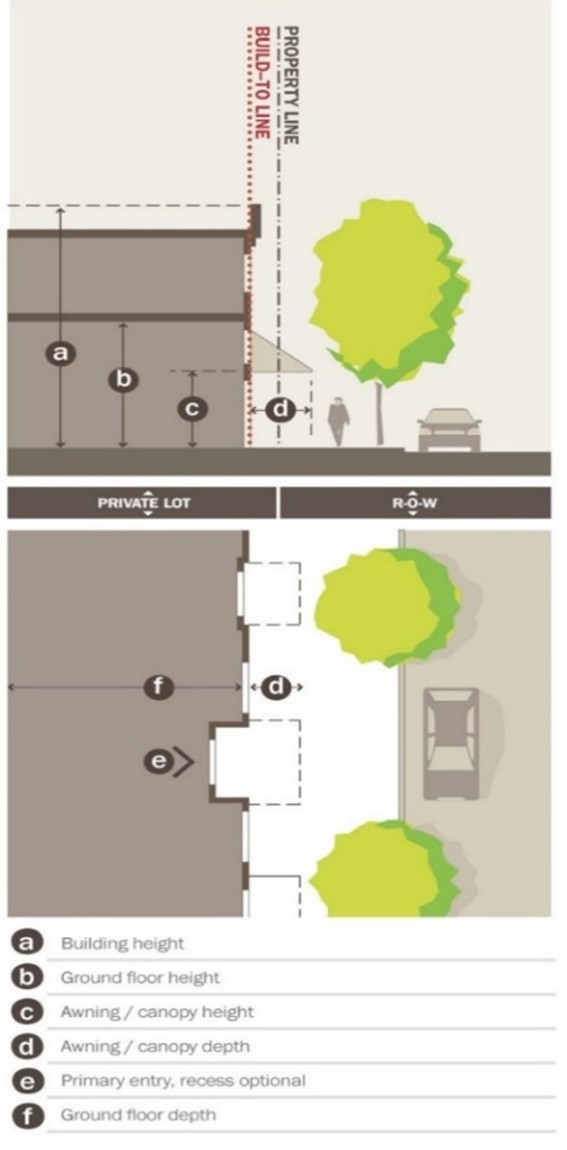
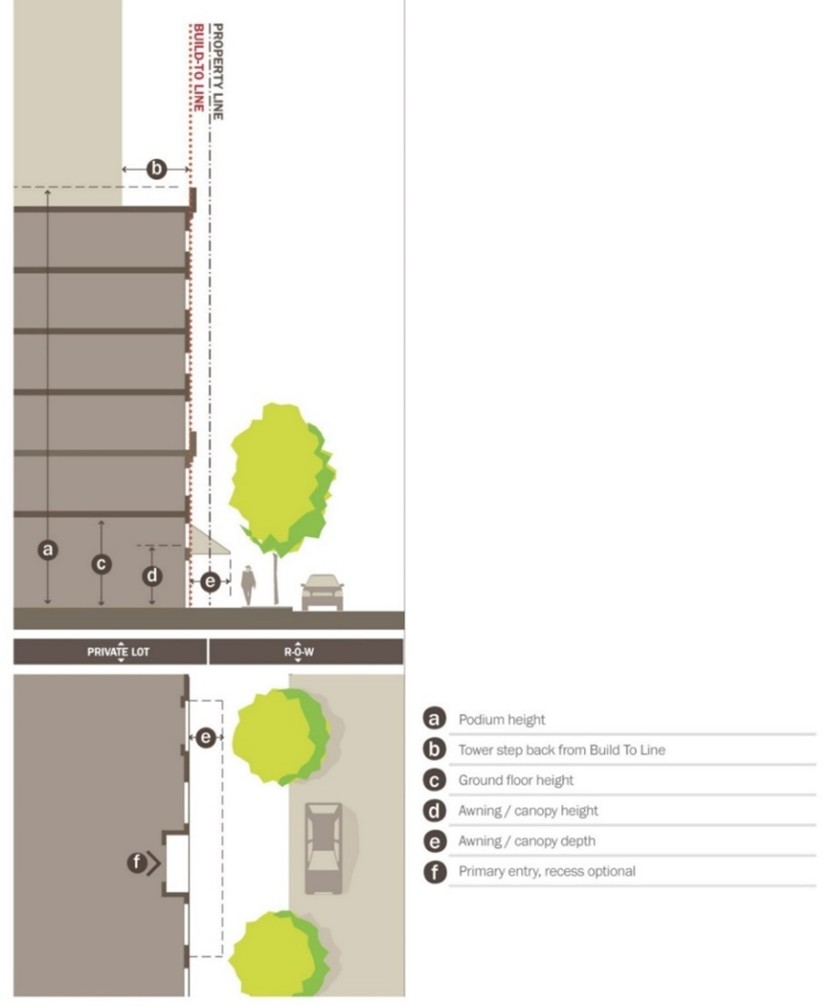
9.16.3. Forecourt Building Frontage
(a) A Forecourt Building Frontage, as set out in Figure 9.8, may be created by recessing a portion of the façade for a portion of the building frontage. The Forecourt Building Frontage should be used in conjunction with the Linear Building Frontage. A Forecourt Building Frontage may be suitable for gardens and/or outdoor seating.
(b) When the Forecourt Building Frontage is a façade at the base of a tower, or a façade as part of a podium building without a tower as set out in Figure 9.9, the tower is stepped back a minimum of 3.0m from the street facing façade of the podium as illustrated in Figure 9.2. The podium has a minimum height of two (2) storeys or 6.0m along corridors, and a maximum height of six (6) storeys or 20.0m.
(c) Forecourts shall conform to the following standards:
i. Courtyard setback: the courtyard portion of a forecourt shall be setback from the street frontage (and secondary street frontage) lot line/principal building façade a minimum of 3m and a maximum of 9.0m. The courtyard portion of a forecourt shall be open to the sky. Courtyards shall be landscaped and/or hardscaped.
ii. Courtyard length: the courtyard portion of a forecourt shall span a minimum of 6.0m along the primary street frontage façade and shall comprise no more than fifty percent (50%) of the primary street building frontage. Courtyards may also span a minimum of 6.0m along the secondary street frontage façade and shall comprise no more than fifty percent (50%) of the overall secondary street building frontage.
iii. Forecourt Building Frontage: the Forecourt Building Frontage shall incorporate the Linear Building Frontage type for building faces on the primary and secondary street frontages that are not part of the courtyard.
iv. Ground floor height: the ground floor shall measure a minimum of 4.5m, floor-to-ceiling.
v. Weather protection: awnings or canopies shall be provided for a minimum of fifty percent (50%) of the overall building frontage and shall comply with the following:
1. Awnings or canopies shall project a minimum of 1.5m and a maximum of 2.5m over the sidewalk or courtyard along a corridor
2. Awnings or canopies shall project a minimum of 1.0m and a maximum of 2.5m over the sidewalk or courtyard not located along a corridor.
3. Awnings or canopies shall provide a minimum of 2.5m and a maximum of 4.0m of vertical clearance over the sidewalk.
vi. Windows: transparent windows shall be provided along at least twenty percent (20%) of the courtyard facing ground floor façade area. See Linear Building Frontage for window requirements for the remainder of the façade.
vii. Primary entry doors: primary building entries shall face the street and/or the courtyard.
viii. Fences: fences and walls with pedestrian openings are permitted within the courtyard setback but may be no greater than 0.9m high and shall be a minimum of twenty percent (20%) transparent.
ix. Parking: parking is not allowed in the courtyard portion of a forecourt; nor is parking allowed on the lot between the building and the street.
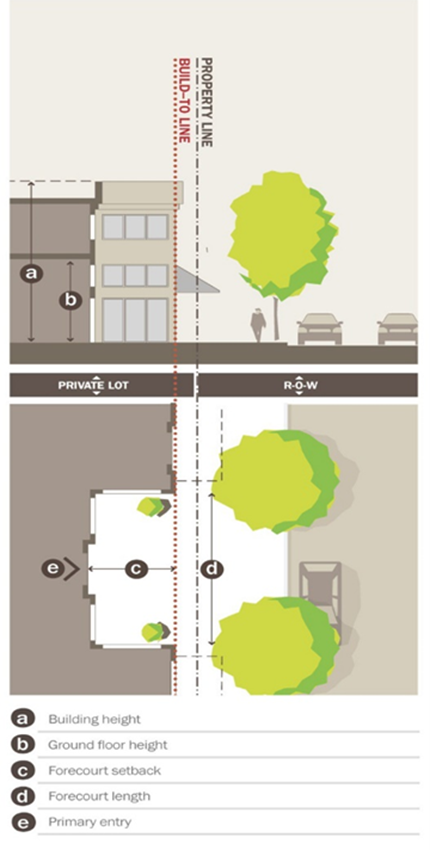
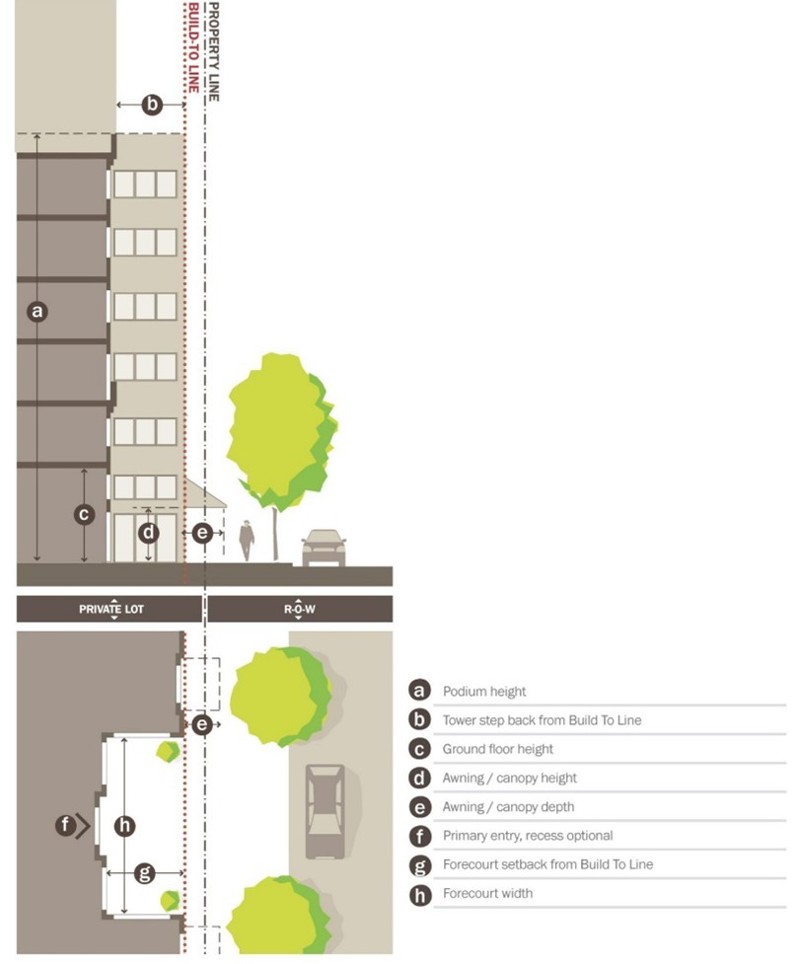
9.16.4. Podium Porch/Stoop/Terrace Building Frontage
(a) The Podium Porch/Stoop/Terrace Building Frontage, as set out in Figure 9.10, is characterized by a façade which is set behind the build-to line and a building entry threshold, such as a porch or terrace, set between the building and the build-to line. The threshold may be elevated above or sunken below grade. The building entry is accessed from this threshold. Landscaping may be provided in the setback area between the building and the sidewalk.
(b) When the Podium Porch/Stoop/Terrace Building Frontage is a façade at the base of a tower, or a façade as part of a podium building without a tower, as set out in Figure 9.11. The tower is stepped back a minimum of 3.0m from the street facing façade of the podium as illustrated in Figure 9.2. The podium has a minimum height of two (2) storeys or 6.0m along corridors, and a maximum height of six (6) storeys or 20.0m.
(c) Podium Porch/Stoop/Terrace Building Frontages shall conform to the following standards:
i. Street-facing setback: the building shall be setback a minimum of 1.5m and a maximum of 4.5m from the build-to line. The entry threshold, including a roof over the threshold, and steps to the threshold may extend up to the build-to line.
ii. Threshold dimensions: the entry threshold (such as a porch, stoop, terrace, patio, or light court) shall conform with the following minimum standards (note: dimensions may vary from the standards below to accommodate universal access ramps if necessary):
1. Minimum of 1.5m depth (clear) from building façade to front of threshold.
2. Minimum 1.8m width (clear) along the building façade.
3. The threshold height shall be no more than 1.8m above grade. An additional threshold may be provided to access a lower level and shall be no more than 1.5m below grade.
4. The threshold shall cover an area of no more than 15.0sq m per building entry.
5. The entry threshold may be covered by a roof no larger than the threshold itself.
iii. Primary entry doors: in order to provide adequate “eyes” on the street, ground floor residential uses shall provide individual building entries to individual residential dwelling units. Building entries shall face the street.
iv. Windows: transparent windows shall be provided along at least twenty percent (20%) of the street-facing façade area. Windows shall be vertically oriented. Vertical windows may be grouped together to create square or horizontally-oriented rectangular windows.
v. Fences: fences are permitted within the primary frontage setback and secondary frontage setback but shall be no greater than 0.9m high and shall be a minimum of fifty percent (50%) transparent.
vi. Landscaping: landscaping shall be provided in the primary frontage setback and secondary frontage setback. Hardscaping is permitted only to provide access to the threshold; all other areas shall be planted.
vii. Surface parking: surface parking shall not be permitted on the lot in between the building and the street.
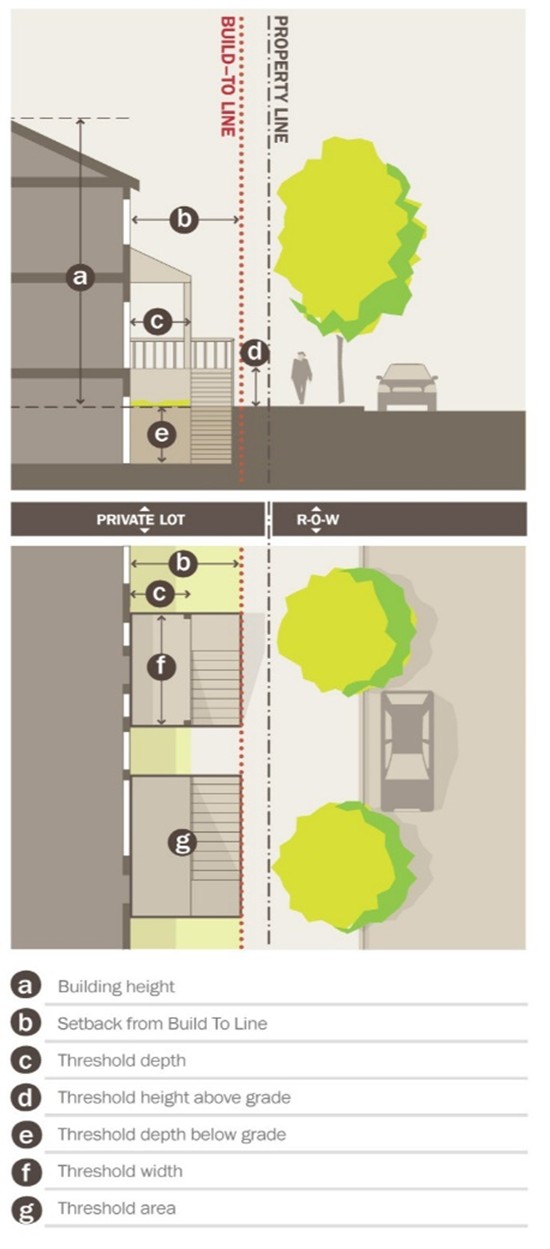
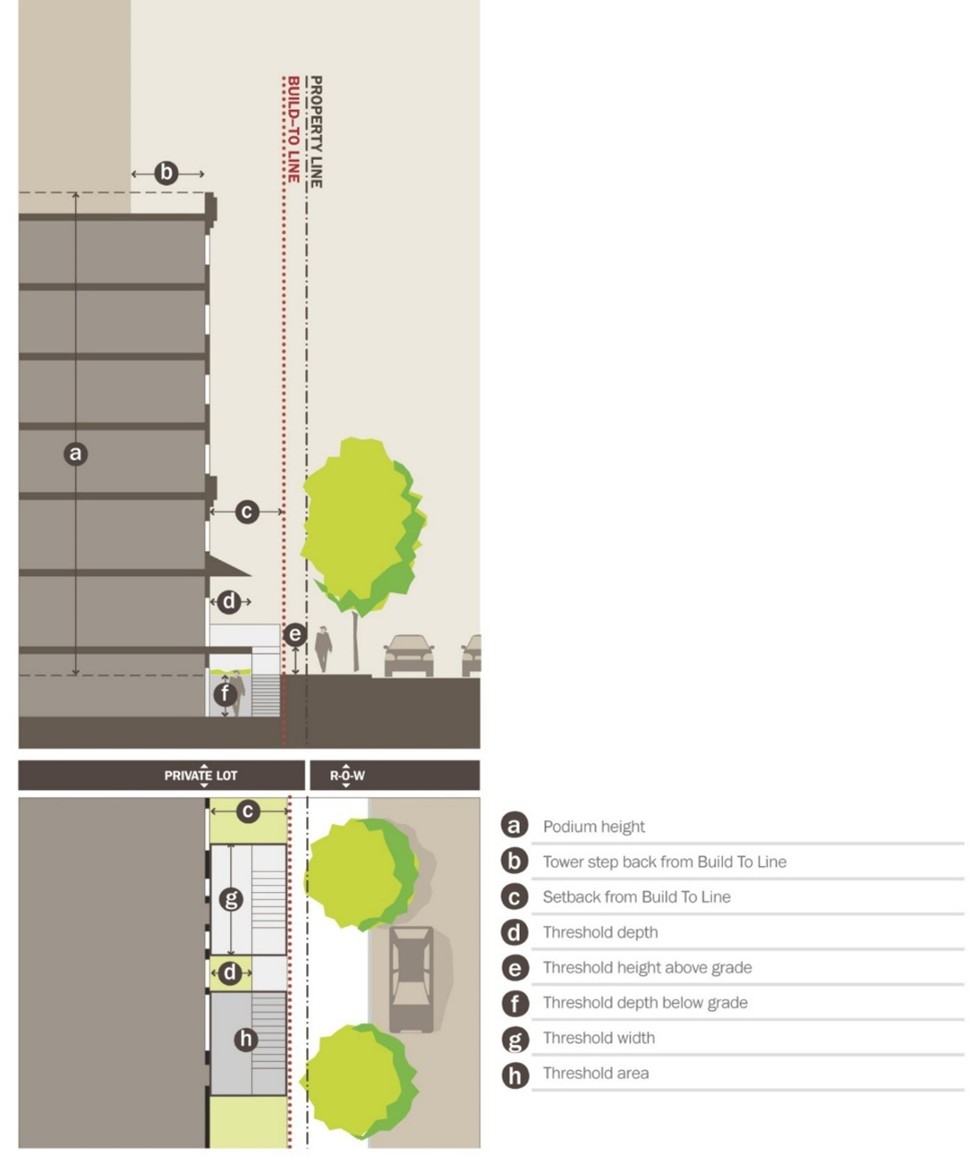
9.16.5. Wrap Building Frontage
(a) The Wrap Building Frontage, as set out in Figure 9.12, is a façade that forms the perimeter of a large single use building that occupies an entire block, or most of a block. It can meet the Linear Building Frontage, Forecourt Building Frontage or Podium Porch/Stoop/Terrace Building Frontage requirements. The Wrap Building Frontage has a minimum depth of 10.0m from the build-to line.
(b) Wrap Building Frontages shall conform to Figure 9.12 and the following standards:
i. Frontage type: the Wrap Building Frontage shall incorporate the Linear Building Frontage, the Forecourt Building Frontage type or the Podium Porch/Stoop/Terrace Building Frontage type standards for building façades adjacent on the build-to line.
ii. Ground floor height: the ground floor shall measure a minimum of 4.5m, floor-to-ceiling.
iii. Minimum depth: the ground floor shall have a minimum depth of 10.0m.
iv. Weather protection: awnings or canopies shall be provided for a minimum of fifty percent (50%) of the overall building frontage and shall comply with the following:
1. Awnings or canopies shall project a minimum of 1.5m and a maximum of 2.5m over the sidewalk along a corridor.
2. Awnings or canopies shall project a minimum of 1.0m and a maximum of 2.5m over the sidewalk not located along a corridor.
3. Awnings or canopies shall provide a minimum of 2.5m and a maximum of 4.0m of vertical clearance over the sidewalk.
v. Windows: transparent windows shall be provided along at least twenty percent (20%) of the courtyard facing ground floor façade area. See Linear Building Frontage for window requirements for the remainder of the façade.
vi. Primary entry doors: primary building entries shall face the street and/or the courtyard.
vii. Fences: fences and walls with pedestrian openings are permitted within the courtyard setback but may be no greater than 0.9m in height and shall be a minimum of twenty percent (20%) transparent. Fences used to screen parking areas shall follow the surface parking screening options standards.
viii. Parking: parking is not allowed in the courtyard portion of a forecourt; nor is parking allowed on the lot between the building and the street.
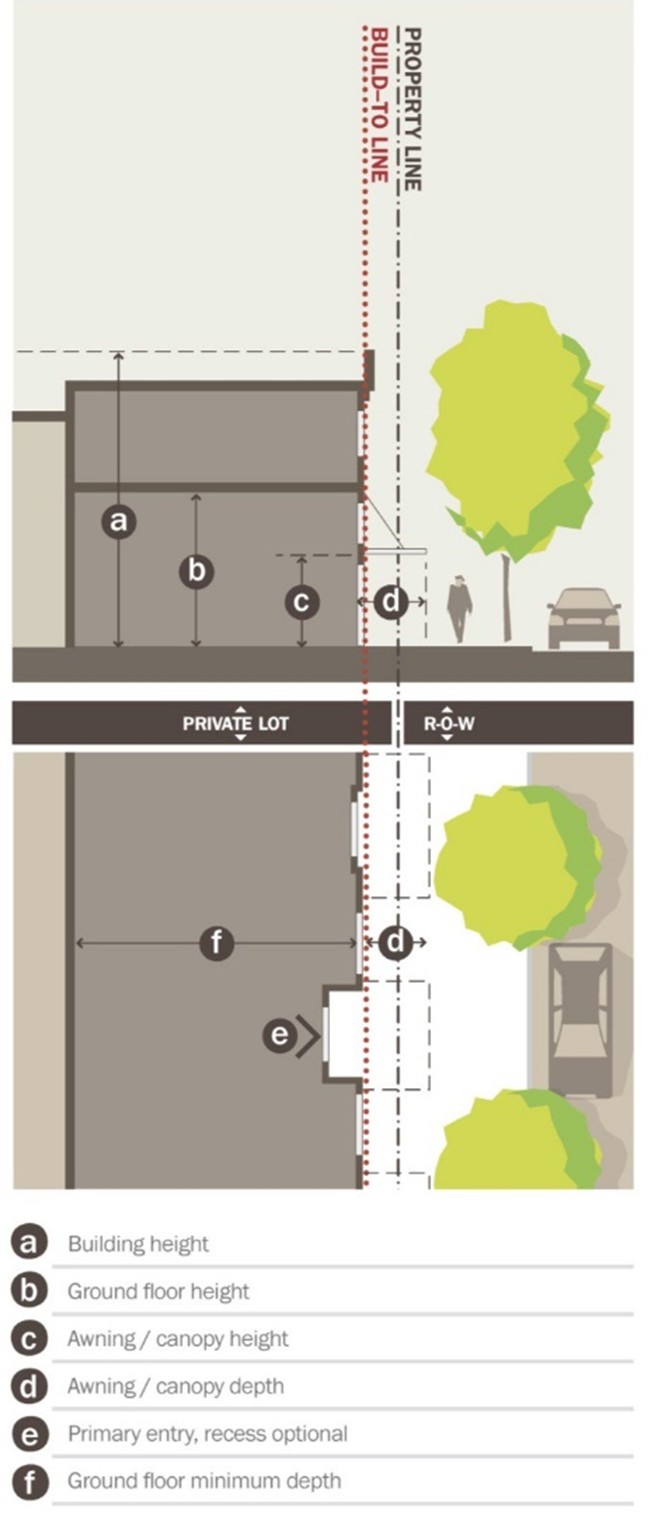
9.16.6. Landscape Building Frontage
(a) A Landscape Building Frontage, as set out in Figure 9.13, is setback from the street-facing lot line by a wide landscaped strip between the building and the sidewalk. This frontage type is appropriate along streets where the existing streetscape may not be conducive to pedestrian-oriented ground floor retail or residential, such as where there is no on-street parking or where streets are very wide. Ground floor entries shall still be provided along and connected to the sidewalk.
(b) Landscape Building Frontages shall conform to Figure 9.13 and the following standards:
i. Front setback: the front façade of the building shall be setback from the street-facing lot line a minimum of 1m and a maximum of 4.5m.
ii. Ground floor height: the ground floor shall measure a minimum of 4.5m, floor-to-ceiling.
iii. Minimum building depth: buildings shall be a minimum of 10.0m deep.
iv. Building entrances: building entrances shall either be covered by an awning or canopy or be covered by being recessed behind the front building façade. If an awning or canopy is provided, it shall provide a minimum vertical clearance of 2.5m and a maximum clearance of 4.5m. If only a recessed entry is provided, it shall be recessed behind the front façade a minimum of 1.0m and a maximum of 1.8m.
v. Windows: transparent ground floor windows shall be provided along a minimum of twenty percent (20%) of the ground floor, street-facing façade area.
vi. Primary entry doors: all buildings shall provide at least one (1) building entrance that faces the street and is directly connected to the public sidewalk via a sidewalk measuring a minimum of 1.8m wide.
vii. Service and utility equipment: building service and utility equipment and outdoor storage of garbage and/or recycling is not permitted along the street-facing building façade or within the required setback from build-to line.
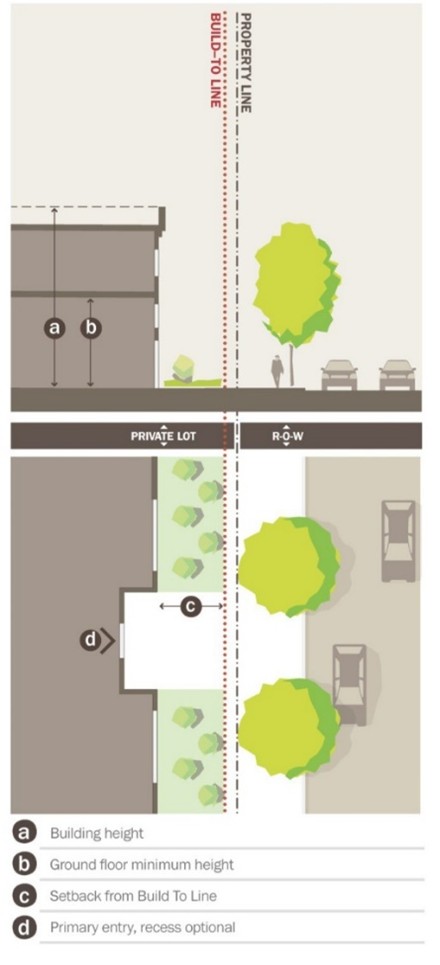
9.16.7. Low Wall and Trellis Landscape Frontage
(a) As set out in Figure 9.14, street-facing lot lines not occupied by buildings, driveways, or pedestrian paths shall be screened with a low masonry or concrete wall and overhanging trellis structure.
(b) Low Wall and Trellis Landscape Frontage shall conform to the following standards:
i. Along all public or private street-facing frontages, surface parking areas shall be screened with a low wall and trellis along the build-to line. The low wall and trellis shall be setback a minimum of 0m and a maximum of 1.5m from the build-to line. Any setback area between the sidewalk and the wall shall be planted or paved with stamped concrete or masonry pavers.
ii. The underside of the trellis portion of a low wall and trellis shall be a minimum of 2.4m above grade and a maximum of 4.1m above grade. The trellis shall be heavy timber or steel (or a similar material) and shall consist of open structure with no decking or awning material. The trellis shall have masonry, heavy timber, or steel (or similar metal) supporting columns spaced no more than 9.0m on centre.
iii. The low wall portion of a low wall and trellis shall be a minimum of 0.5m and a maximum of 0.9m and have a minimum depth of 0.4m. The low wall shall be wood, masonry, and/or concrete.
iv. Surface parking shall be setback a minimum of 1.0m from the low wall and trellis. Low shrubs, groundcover, and climbing plants shall be provided in this area.
v. Openings in the low wall and trellis are allowed for pedestrian pathways, sidewalks, plazas, and driveways.
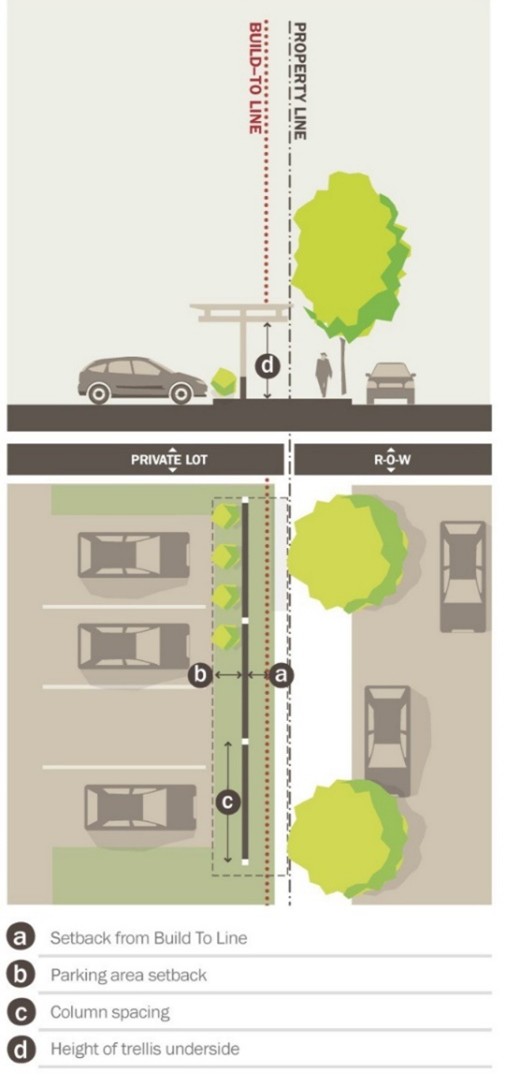
9.16.8. Urban Fence or Wall Frontage
(a) As set out in Figure 9.15, street-facing lot lines not occupied by buildings, driveways, or pedestrian paths shall be screened with an open framework wall or fence of either metal, wood, masonry, or a combination.
(b) Urban Fence or Wall Frontage screening shall conform to the following standards:
i. Along all public or private street-facing frontage, surface parking areas shall be screened with a wall and/or fence along the build-to line. Walls shall be wood masonry, and/or concrete; fences shall be made of wrought iron, steel, or a similar material (but not chain-link) and shall be dark in colour. The fence shall be at least 0.6m high and no more than 0.9m high. Fences may be no more than fifty percent (50%) sight obscuring. The wall shall be at least 0.6m high and no more than 0.9m high.
ii. The Urban Fence or Wall Frontage shall be setback a maximum of 1.5m from the sidewalk. The area between the urban fence or wall shall be hardscaped with either masonry pavers or stamped concrete.
iii. The surface parking area shall be setback, at a minimum, an additional 1.5m to provide room for required landscaping and stormwater infiltration and/or retention.
iv. In addition to the required fence or wall, trees and shrubs shall be provided. One large tree is required every 9.0 linear metres minimum along all public or private street-facing frontages, except where it is necessary to ensure adequate traffic visibility. The minimum shrub height shall be the same as the height of the wall or fence, and the maximum height shall be no more than 1.8m.
v. Openings in the urban fence or wall are allowed for pedestrian pathways, sidewalks, plazas, and driveways.
vi. Ground cover plants shall fully cover any remaining landscaped area between the parking area and the urban fence or wall.
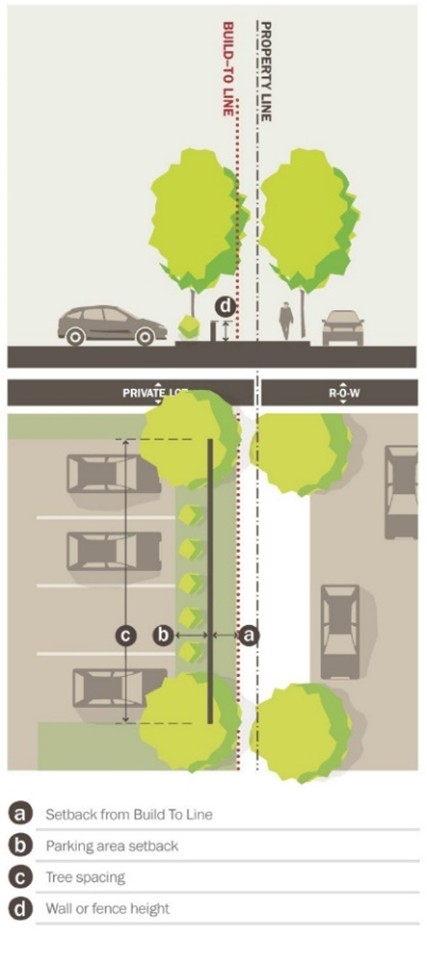
9.16.9. Landscape Setback Frontage
(a) As set out in Figure 9.16, street-facing lot lines not occupied by buildings, driveways, or pedestrian paths shall be setback behind a planted landscape area consisting of trees, shrubs, and groundcover plants.
(b) Landscape Setback Frontages shall conform to the following standards:
i. Along all public or private street-facing frontages, surface parking shall be setback a minimum of 3.0m behind the build-to line.
ii. The surface parking area shall be screened with a continuous row of hedges or shrubs immediately adjacent to the parking area, except where there is a driveway. The shrubs shall be a minimum of 0.6m high and shall be mostly opaque year-round.
iii. In addition to the required shrubs, one (1) large tree is required every 9.0 linear metres minimum along all public or private street-facing frontages. The shrubs/hedge shall be interrupted with a gap of up to 0.6m wide in order to accommodate trees.
iv. Grass or ground cover plants shall fully cover the remainder of the landscaped area between the parking area and the sidewalk.
v. A 0.9m high masonry wall may be substituted for the shrubs but the trees and groundcover plants are still required.
vi. Openings in the setback are allowed for pedestrian pathways, sidewalks, plazas, and driveways.
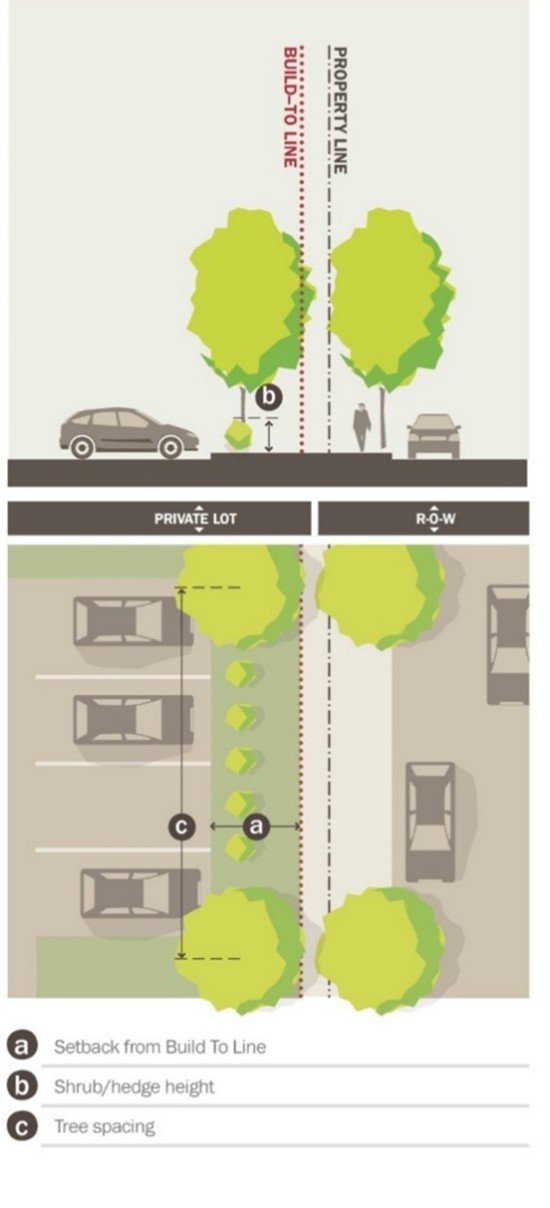
9.17. Special Urban Design Regulations
9.17.1. Introduction
(a) The regulations in this section are required for all development in the Downtown Major Redevelopment Zone and the Franklin Avenue Re-Urbanization Zone. The regulations in this section are also required for buildings greater than 1,000.0sq m in the Neighbourhood Stabilization Zone and the Recreation Zone. These regulations are applied in addition to the development standards for site design, street types, and building frontage types and landscape frontage types. In conjunction with the other applicable development standards, the purpose of these design regulations is to ensure achievement of a high-quality public realm and building design.
(b) The special urban design regulations are as follows:
9.17.2. Regulations for High Quality Public Realm
(a) Design quality: plan rights-of-way, and public open space as if they were outdoor rooms, designed with the same care to circulation, proportion of space, quality of materials, comfort, safety and attractiveness as indoor rooms.
(b) Through block connection frontage: orient building elements such as main entries, lobbies, windows, and balconies to face through block connections and public open space. Create a pedestrian-friendly environment within through block connections and adjoining public spaces by orienting façades, entrances, outdoor seating areas, canopies, landscaping and other features that lend visual interest and a human scale.
(c) Seating opportunities: include a wide variety of seating opportunities in the design of public open space, including benches, widened windowsills, widened edges of landscape planters, or wide steps. Integrated seating for pedestrians should be oriented to the active edge of the parcel, the main entry of the building, or toward a corner.
(d) Through block connection weather protection: develop integrated weather protection systems at the sidewalk-level to mitigate the effects of harsh weather, glare, shadow and reflection on pedestrian environment.
(e) Public art: consider including public art that meets a high standard of quality and permanence as part of a through block connection, ensuring that while the public art may be located on private land, it is visible and accessible to the public. Encourage public art as an integral part of larger developments and parcels.
9.17.3. Regulations for Buildings
(a) Quality and permanence: use design principles, construction techniques and building materials that promote quality, permanence and adaptability in buildings.
(b) Location of services and equipment: building mechanical equipment that produces offensive odours, noise, and/or air movement should be located so as not to negatively impact the pedestrian environment. Incorporate service areas for large vehicle access in a manner that does not detract from the pedestrian environment. These service and equipment areas include loading areas, recycling dumpsters, trash collection and storage areas, and vehicle access locations.
(c) Pedestrian-scaled signage and lighting: develop integrated identification, sign, and sidewalk oriented night-lighting systems that offer safety, interest, and diversity to the pedestrian.
(d) Barrier free access: integrate access systems for all people with the building’s overall design concept. Ensure barrier-free design features that facilitate movement for all people, such as elevators, lifts, and ramps, are well integrated into the overall design concept.
(e) Parking structure design: orient and screen parking structures to minimize exposure and visibility of parking floors along the street-facing façade. Incorporate materials, colours and façade articulation to de-emphasize the visual difference between parking structure screening and habitable space within the same or adjacent buildings.
(f) Building location: locate buildings to frame the public spaces and streets, and create strong edges to the outdoor urban realm. Locate buildings in the perimeter of the block, allowing for courtyards in the interior.
(g) Weather protection: incorporate features like covered sidewalks, walkways and atriums that provide shelter from the extreme cold weather conditions that characterize the local climate.
(h) Skyline: design individual building roofs to create visual interest and to ensure they work together to form a cohesive and attractive skyline. Consider tall buildings that cluster together, particularly in the downtown unlimited height area, the Franklin transit nodes and gateways, as sculptural peaks that mark a specific neighbourhood in the City Centre Special Area. These neighbourhood markers work together as sculptural features to create a sense of drama, enhance the image of and call attention to the City Centre Special Area as a whole.
(i) Building rooftops: design rooftops to contribute positively to the skyline and to establish a signature image for the district and the city as a whole. Locate necessary building functions such as heating, ventilating and air conditioning systems, elevator penthouses, and other structures such as transmission towers to mitigate visual impacts, and to integrate them into the design of rooftop architecture. Develop rooftops as habitable space to offer special view opportunities from the tops of buildings.
(j) Corners: highlight building corners by varying building heights, changing the façade plane, with large windows, awnings, canopies, marquees, signs, or pedestrian entrances. Locate flexible sidewalk-level retail opportunities at building corners.
(k) Towers: design and orient towers to maximize views, sun exposure at the street level, through block connection and adjoining open space, and to articulate the downtown skyline.
(l) Podiums: enhance podium roofs when they are visible from adjacent developments through the use of patios, gardens or green roofs.
(m) Within the SCL2 areas, encourage development of buildings of various heights to create variation along the skyline in these areas, and to reduce shadow impacts on adjacent parkland. Development of rows of buildings with similar heights in these areas is not encouraged.
9.17.4. Regulations for Specific Streets and Gateways
(a) MacDonald Avenue: locate buildings along MacDonald Avenue to provide a rhythm of fine-grained retail establishments with direct access to the street that contain numerous shop fronts, entrances, and a variety of textures and building materials to enhance the pedestrian environment.
(b) Gateways: orient building and landscaping features toward designated gateways to identify district entrances and transitions from one land use district to another. Building features such as arches, arcades, columns and landscape features such as fountains, planting and sculptural art can be used to define gateways.
Contact Us
PULSE
Submit a request
Phone: 780-743-7000
Toll free: 1-800-973-9663
Subscribe for RMWB updates
Stay up to date on the services, programs and projects in your neighbourhood!