Snow Plowing and Removal - DEMO

Quick Links


About Snow Clearing and Removal

Winter maintenance is carried out on more than 510 roads in Fort McMurray following the Urban Ice and Snow Control Program Policy (OPE – 150). Crews work across Fort McMurray to plow, remove and haul snow so people can travel safely.

On-street parking restrictions vary depending on the type of road, whether it is a primary, secondary, or tertiary route, or a residential street included in the Winter Maintenance Zone (WMZ) program. Following winter parking restrictions helps crews work more efficiently and complete maintenance faster.

How snow is cleared also depends on the type of road. The classification and priority of roads are determined by traffic volume, usage and location:

Primary Routes

  • Thickwood Boulevard
  • Confederation Way
  • The downtown business area (Morrison Street, Hardin Street)
  • Franklin Avenue
  • Hospital Street and MacKenzie Boulevard

Secondary Routes

  • School zones
  • Transit routes
  • Main access roads to neighbourhoods

Tertiary Routes

Roads that are steep, narrow, or have unique features like Killdeer Way and Crane Rise

Residential Streets

Neighbourhood streets, serviced by the Winter Maintenance Zone program

Learn more about Winter Maintenance

Snow plowing is when snow is pushed from the roadway to the side or to the centre of the road to maintain at least one traffic lane, in addition to space for street parking. Snow plowing operations are less time-consuming than snow removal operations and happen more frequently.

If you live on a Primary, Secondary or Tertiary Route, you can park on your street when it is being plowed, as the street is big enough for the plow to go around parked vehicles. Other parking restrictions may apply, so always look for posted street signage.

Snow plowing priorities:

  1. Primary routes will be plowed and sanded continuously during a snowfall.

  2. Secondary routes will be plowed and sanded after primary routes, followed by high-volume intersections and turning lanes.

  3. The first 15 metres from all stop and yield signs will be plowed to both sides of the street and sanded as required. (This will only be done after primary and secondary streets are completely plowed.)

  4. Snow accumulation of four centimetres or more will be removed from designated trails, sidewalks, parking lots, stairs and boardwalks within 48 hours. Aggregates and ice-melting products will be applied as required.

  5. Residential streets will be plowed as per the Winter Maintenance Zone schedule. Plowing to both sides of the street, adjacent to the curb. Driveway access is the responsibility of the resident or property owner. Learn more about the Winter Maintenance Zone program.
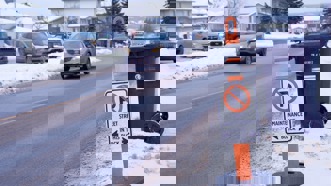
Snow removal (or snow hauling) is the process of loading snow into trucks and hauling it to a snow disposal site. A snow removal operation takes more time and resources than snow plowing and typically happens only once or twice per winter season. 

If you live on a Primary, Secondary or Tertiary Route, watch for temporary “no parking” signs on your street. 

Temporary no parking signs are placed 24 hours in advance of planned maintenance. After 24 hours, on-street parking restrictions will be in effect and parked vehicles must be removed from the street until the signs are taken away. 

Snow removal priorities:

  1. Snow will be removed from Primary and Secondary routes where there is limited on-street storage. 

  2. Snow may be hauled from residential streets when the remaining parking and driving width is reduced to 5.5 metres or less.

  3. Within the first 15 metres from all stop and yield signs, snow will be plowed to both sides and/or removed.

  4. Height of snow windrows will not exceed one meter to maintain sight lines and visibility.

  5. During snow hauling, street signs will be posted 24 hours in advance.

  6. Snow removal on residential streets will be done as needed. High-density residential areas, safety concerns and sight line areas will be completed on a priority basis. Some exceptions may apply due to specific street configurations and weather trends.

Vehicles left in active subzones and where temporary no parking signs are posted are subject to a $120 Notice of Violation plus towing fees. (Bylaw 25/020

If you live on a primary, secondary or tertiary route, temporary no-parking signs are placed 24 hours in advance of planned winter maintenance. 

After 24 hours, on-street parking restrictions will be in effect from 7 a.m. to 6 p.m.

Parked vehicles must be removed from the street until the signs are taken away. 


Temporary no parking sign on the street with a vehicle driving by


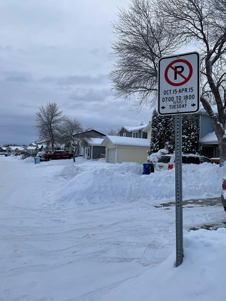
All residential streets in the Winter Maintenance Zone (WMZ) program are assigned a subzone and one designated maintenance day each week. This information is posted on permanent street signs, and you can also find it using the online Find Your Zone tool.

When your subzone is active, vehicles must be removed from the street between 7 a.m. and 6 p.m. only on your designated maintenance day.

Subzones usually alternate each week between being active and relaxed. This means you are required to move your vehicle off the street once every two weeks.


Keeping our sidewalks clear and safe for pedestrians is a shared responsibility between residents and the Municipality.

Sidewalks next to commercial or residential properties are the responsibility of the owners, occupants or tenants and must be cleared within 48 hours after a snow fall. The Municipality will clear snow that has spilled over on sidewalks in active Winter Maintenance Zones while maintenance was occurring.

Sidewalks, pathways and trails that border municipally-owned land are the responsibility of the RMWB to keep clear and safe. Routes to schools and emergency facilities will be prioritized, followed by sidewalks along primary and secondary routes and then trails. Groups that use the trails throughout the winter assist with grooming duties.

Winter maintenance in the southern rural communities is done by municipal contractors, and includes: 

  • Snow plowing and snow removal. 

  • Sanding/salting asphalt roadways whenever needed to create a safe driving surface. 

Snow plowing 

  • Primary (high-traffic) roads are plowed within 24 hours of snowfall. 

  • School routes will be plowed within 24 hours for easier school pick-up and drop-off. 

  • Secondary roads are plowed within 48 hours 

  • Gravel roads are plowed within 72 hours.  

  • Contractors will try to remove windrows (snowbanks) at residential and commercial driveways where possible. 

Snow removal:  

  • Contractors start snow removal when snowbanks are too high and block safe sightlines at intersections. 

Help your community stay clear of snow 

  • Do not shovel/push snow onto the road or into ditches, as this creates flooding issues in the spring. 

  • Remove garbage and recycling bins from the roadside to leave room for plowing. 

  • Airport operations take priority over all other snow clearing activities.

  • The service level during winter is generally bare pavement on all roads and parking lots.

  • Church parking lots are serviced once per week or per snow fall.

  • Sidewalks are cleared per snow fall.

Alberta Transportation is responsible for the maintenance of Highways 63 and 881, including the interchanges accessing the highways. For more information on highways, phone 1-800-390-2242 or follow the province on Twitter at @ABTransComm

Frequently Asked Questions

Residential streets will be plowed according to the Winter Maintenance Zone schedule. If your home is located on a secondary or tertiary route, winter maintenance will be done more regularly.

Alberta Transportation is responsible for the maintenance of Highways 63 and 881, including the interchanges accessing the highways. For more information on highways, phone 1-800-390-2242 or follow the province on Twitter at @ABTransComm

  • Every residential street in Fort McMurray has been assigned a WMZ "subzone" and one designated weekday for maintenance. You can find this information on posted street signage or by using the Find Your Zone tool
  • There are four WMZ subzones: WMZ-1, WMZ- 2, WMZ-3, and WMZ-4 (also known as subzone 1, subzone 2, etc.). It's important residents know their subzone and the designated weekday that winter maintenance may occur on their street.
  • For the weeks when your subzone is active, on-street parking restrictions are in effect only on your designated maintenance day from 7 a.m. to 6 p.m.
  • Typically, your subzone will be active every second week, meaning you need to move your vehicle off the street twice a month on your designated day. However, it’s still important to check the status of your subzone every week during the winter.
  • There will be times when your subzone is active, and no maintenance occurs. This typically happens when crews are performing snow removal or there are numerous vehicles parked in active subzones.
  • From Oct. 15 to April 15, WMZ subzones may be activated or relaxed depending on the need for winter maintenance. Typically, when subzones are activated, others will be relaxed to allow more flexibility and options for on-street parking.
  • If a subzone is relaxed, on-street WMZ parking restrictions are NOT in effect and vehicles can park on the street without being ticketed or towed. Please watch for other posted signage as other parking restrictions may apply.
  • At the beginning of the WMZ season, snow must first be plowed off the road, with snow removal happening periodically in the following weeks.

Yes. Vehicles need to be removed from both sides of the street to allow our maintenance equipment to enter and safely clear the entire street.

The towing time on invoices begins once the towing contractor leaves their location to travel to site. Once on-site, the following tasks are performed:

  • Sign and receive paperwork from Bylaw Services
  • Take four pictures of the vehicle
  • Load the vehicle onto the tuck
  • Travel back to storage facility on Hwy 69
  • Off-load the vehicle
  • Take four additional pictures of vehicle
  • Report paperwork to office

Storage fees are also applied to the invoice.

Ticket fines are collected through the Municipal Law Enforcement. Funds from ticketing revenue are returned to the Municipality's general revenue, which are then used to recover costs for municipal programs.

An independent, third-party company performs towing and impound services for Winter Maintenance Zones. The Municipality does not perform this function and therefore does not generate any revenue from towing or impound services.

Snow is plowed to the right-hand side to clear roads and keep them safe. With regular residential plowing, residents may notice small windrows accumulating along the sides of roads and at the end of their driveway.

Crews are removing windrows that are higher than 15 cm and have been created by a snowplow in an active Subzone. Windrow removal only applies to residential streets included in the WMZ program.

Windrow removal is intended to help residents clear their driveways when a larger than normal windrow is left from a plow in an active Winter Maintenance Zone. It is still each resident's responsibility to clear snow from their driveway, including the windrow at the end of their driveway (unless it is larger than 15 cm and created from a plow in an active Subzone). This approach is modelled after best practices from other municipalities in Alberta.

Residents are encouraged to clear snow from their driveway a short time after snowfall or road maintenance. As we live in a northern community, sub-zero temperatures are common and can make the snow harder to clear as the temperatures drop.

Residents are reminded that when shoveling driveways, sidewalks or windrows, snow cannot be placed back onto the road. Snow can be put on lawns or right-of-ways, out of the way of traffic and pedestrians.

The Snow Angels Program a volunteer service is available for seniors 65 years and older.

Yes. However, we are unable to plow snow without pushing it up against fences and garage doors. So, alleyways require snow removal instead of just snow plowing. Snow removal typically begins in January on primary and secondary roads, followed by alleyways.

Snow plowing

Snow is pushed from the roadway to the sides of the road or the center to maintain at least one traffic lane and space for on-street parking. This process is not as time consuming as snow removal, so it happens more often.

Snow removal

Snow is loaded into trucks and hauled to storage sites. This is more time consuming and costly than snow plowing, so it happens less frequently.

Residents and commercial businesses are responsible for clearing the sidewalks adjacent to their property, in accordance with Bylaw 21/010

Municipal crews will clear any snow that they place on sidewalks during winter maintenance operations.

Residents are also responsible to clear snow from their driveways, including the windrow at the end of their driveway. This approach is modelled after best-practices from other municipalities in Alberta.

Snow and ice must be immediately removed if a property has any kind of building adjacent to or erected within three metres of any public place. Accumulated snow or ice on the roof poses a danger and must be immediately removed with due precaution taken to warn and protect passersby. If any premises has an awning extending to any degree over a public place, it must be kept free of snow and ice; if water does drip from the awing, the owner/occupant/tenant must clean it up to prevent ice from forming.

The municipality may use minimal sand or salt in residential areas after plowing if conditions warrant. The standard practice is to sand the intersections only. In other municipalities where only salt is used, lawns come back every spring with a little raking, water and fertilizer.

The municipality uses minimal salt because it only works in temperatures down to -14°C. Instead, we use a sand mixture treated with calcium chloride, which adheres to road surfaces and works in temperatures colder than -15°C.

No. It is not permitted to have an extension cord on the surface of sidewalks. However, extension cords may be suspended above sidewalks, no less than 2.4 metres – between Nov. 1 and Mar. 30. This will ensure safety of pedestrians, and also allow for residents to keep their vehicles plugged in during winter months.

Extension cords that are running across sidewalks are a hazard for snow removal crews, as well as for pedestrians and homeowners. To avoid injury to people or damage to equipment, cables need to be visible.

A right-of-way is a type of easement or access reserved over the land for transportation purposes and can be used for a sidewalk, utility, or the road itself. This property is owned by the municipality and the width of right-of-ways is based on our Engineering Servicing Standards. Many factors are taken into consideration when calculating this width and can vary based on location and road classification.

Council approved the latest version of the Urban Ice and Snow Control Program Policy (OPE – 150) on Oct. 10, 2023.

The purpose of the policy is to set winter snow and ice control standards. It helps ensure that municipal roads and sidewalks are maintained to:

  • reduce hazards and economic loss,
  • prioritize safe access to emergency vehicles and transit, and
  • provide guidelines for management and operating personnel in the handling of winter maintenance operations.

Subscribe for RMWB updates

Stay up to date on the services, programs and projects in your neighbourhood!